

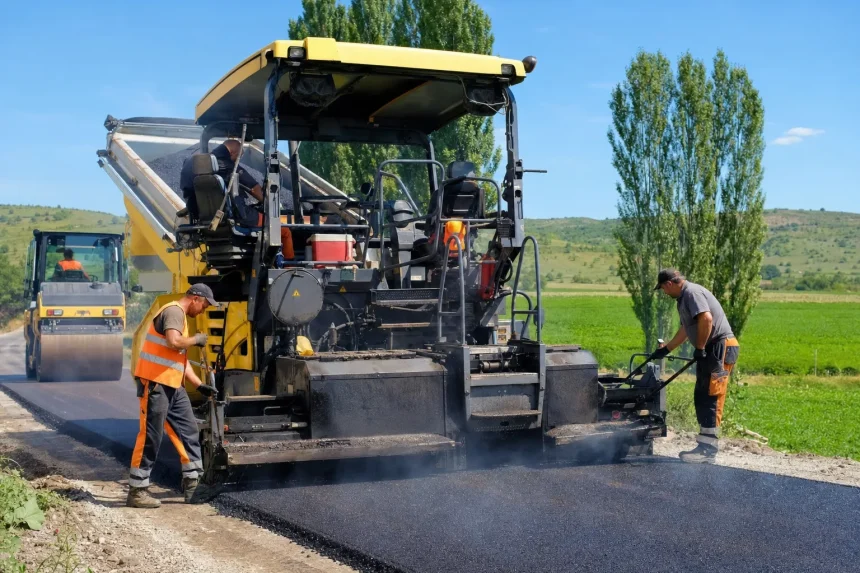
STRABAG România announced on Monday that it had signed with the Timiș County Council to modernise the county road DJ 595D between Moșnița Veche and Ghiroda, for 23.3 million lei. In the local press that is a regional infrastructure story: a road between two communes near Timișoara gets rebuilt. Read against the group’s wider record it is something less remarkable and more interesting — one of many, arriving in a week like any other. Over the thirty days to Monday the same group won 87 public contracts across four countries in our record, and over the last twelve months, 331 across eight.
What a month looks like
The thirty-day picture is dominated by the countries where the group’s local subsidiaries are strongest: 28 wins in Poland, 25 in the Czech Republic, 23 in Germany and 11 in Austria. These are not megaprojects. They are the ordinary substance of European public works — a pedestrian and cycle route along a national road in Poland, the revitalisation of a small town square in the Czech Republic, a framework for cable and line construction in Austria. The volume, not the size, is the point: this is a contractor whose business model is winning constantly at the municipal and county scale rather than occasionally at the national one.
The twelve-month spread
Widening to a year gives 331 contracts across the Czech Republic, Poland, Germany, Switzerland, Slovakia, Austria, Hungary and Slovenia, with the Czech Republic alone accounting for 190. The largest single award in euro terms is a €60M package in Dresden for the Königsbrücker Straße — road, tram track and civil works in one lot. Below it the scale drops quickly: €17M for bridges and retaining walls near Beuel, €14M for a housing estate in Hrastnik, €13M for an education campus in Völs. The Romanian county road at 23.3 million lei, roughly €4.6M, sits comfortably inside the group’s normal range rather than at the top of it.
| Largest wins, last 12 months | Market | Value |
|---|---|---|
| Königsbrücker Straße, road, tram and civil works | Germany | €60,000,000 |
| S 13 bridges and retaining walls, Beuel | Germany | €17,000,000 |
| Resnica housing estate, Hrastnik | Slovenia | €14,000,000 |
| Education campus, Völs | Austria | €13,000,000 |
| Technical building management, federal properties | Germany | €13,000,000 |
| District heating connection framework | Germany | €10,000,000 |
| Road reconstruction 2025 | Slovakia | €10,000,000 |
| DJ 595D, Moșnița Veche to Ghiroda | Romania | 23,300,000 lei |
Forty-two names for one contractor
The detail worth carrying away is administrative. Those 331 wins are recorded under 42 distinct company names — STRABAG a.s., STRABAG Sp. z o.o., Strabag AG, STRABAG SIS a.s., STRABAG Pozemní a inženýrské stavitelství and so on, with national suffixes, spelling variants and capitalisation differences layered on top. Anyone trying to measure a large contractor’s public-sector footprint by matching a company name will therefore undercount it, and will undercount it differently in every country. This is the single most common error in supplier-concentration analysis, and it is invisible unless you go looking for the variants.
What the count does not include
One honest caveat about the figure. The 331 is a floor, not a total: it counts contracts where the winner is actually named in the published record, and the share of awards that name a winner varies enormously between markets. Romania is a case in point — the Timiș contract that prompted this piece is known from the company’s own announcement, not from a machine-readable award notice. So the geography above describes where winner names are reliably published as much as it describes where the group works.
WHY IT MATTERS
Concentration in public works is usually discussed at national level, where one contractor looks like one of several credible bidders. Seen across borders the same firm is winning constantly, in volume, at the scale of county roads and town squares — the tier where local competitors are smallest and where a national analysis never looks. If you are bidding against a group like this, the relevant question is not whether it is big but whether it is already present in your county, because its cost base there is already paid for.
Data: Otnox — live procurement intelligence across 56 markets. Basis: the Timiș contract as announced by the company and reported by economica.net; the comparison drawn from 331 awards naming a STRABAG entity as winner in our own record, 2025-07-27..2026-07-27.