The issue is whether restrictions on MPs serving in procurement-related public bodies should be placed in Ghana’s Constitution rather than left to ordinary legislation or administrative rules.
The proposal before Ghana’s constitutional debate
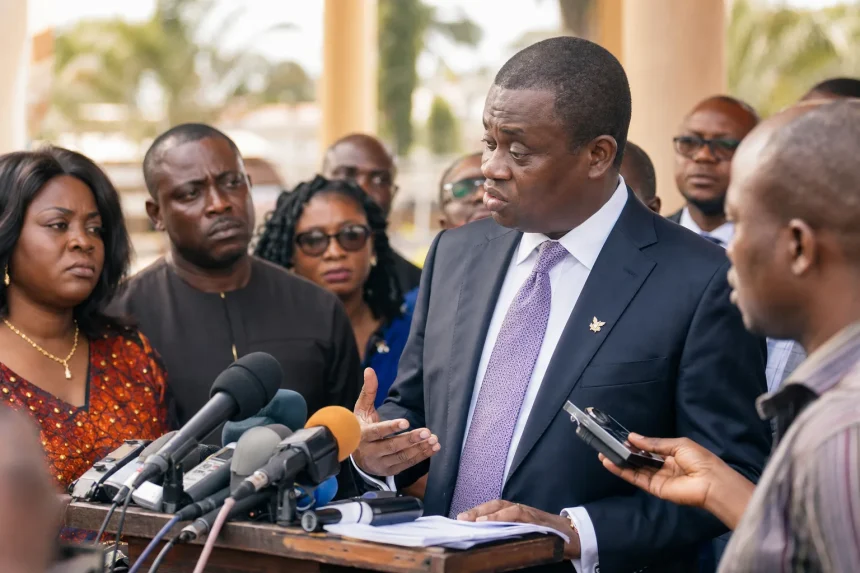
The New Patriotic Party has called for stricter constitutional restrictions on sitting Members of Parliament serving on public boards and procurement bodies of publicly funded institutions. The position was presented by Sulemana Tampuli Alhassan, the MP for Gushegu, at a press conference on Thursday, September 17, 2026, as the party set out its position on proposed constitutional reforms. The NPP said excluding MPs from these roles could strengthen Parliament’s independence, reduce potential conflicts of interest and improve public confidence. The source reports a party proposal, not an adopted rule, and records no finding that any MP has improperly influenced a procurement process.
What a constitutional safeguard would change
The procurement mechanism at stake is the appointment of public officials to oversight or decision-making bodies within publicly funded institutions, including bodies connected with procurement. The NPP supports the Constitutional Review Committee’s recommendation for stronger conflict-of-interest safeguards, including a restriction on MPs serving on public boards and procurement bodies. A constitutional restriction would sit at a higher legal level than an ordinary code of conduct or administrative instruction. The party argues that this would make the safeguard more durable and less dependent on later policy choices, although the source does not describe proposed wording or the process required to adopt the change.
The stated case for separating roles
Alhassan said the NPP believes constitutional guardrails would better protect the integrity and independence of Parliament. The party’s argument is that an MP who also holds a position on a public board or procurement body could face a perceived or actual conflict between parliamentary responsibilities and duties within a publicly funded institution. Separating those roles, in the NPP’s view, could help safeguard public resources and reinforce confidence in Parliament. The source also records a different approach taken by the party’s government: it rejected the need for constitutional amendments and relied instead on proposed legislation establishing a code of conduct for public officers.
What remains unresolved
The reported proposal leaves open several practical questions for public buyers, bidders and Parliament. The source does not state which existing appointments would be affected, whether any transition arrangements would apply, or how the restriction would interact with board and procurement-body rules. It also does not report a decision by the Constitutional Review Committee, Parliament or the government to introduce or enact the proposed safeguard. For procurement systems, the transferable point is the distinction between managing conflicts through legislation or administrative controls and placing an eligibility restriction in the Constitution. The NPP says the latter would provide the stronger and more lasting barrier.
IN NUMBERS
Ghana’s NPP has therefore backed a constitutional approach to keeping sitting MPs off public boards and procurement bodies, while the source records no completed reform or proven misconduct linked to the current arrangements.
Reported from myjoyonline.com, 2026-09-17. The Tender Wire is published by Otnox.