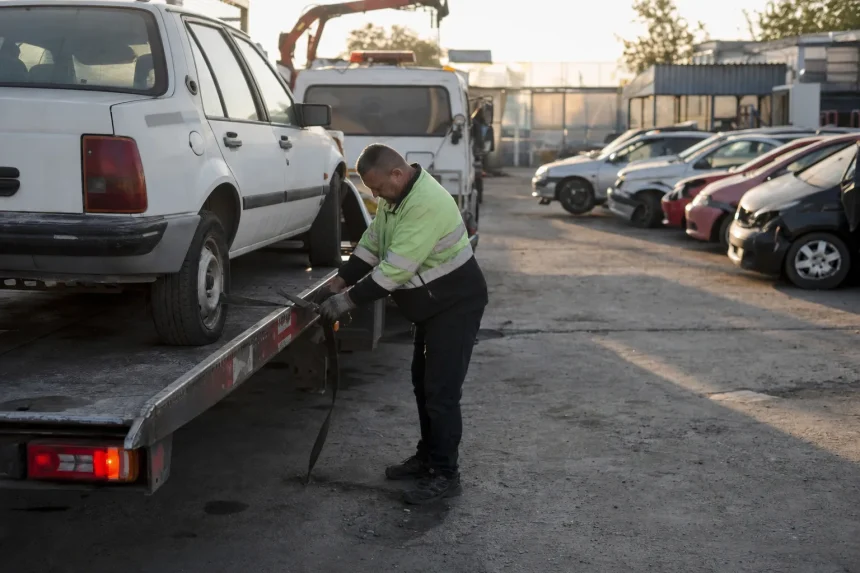
How will Bucharest’s new framework divide towing responsibilities, standardise charges and manage vehicle records across the capital?
One framework for the whole capital
Bucharest’s General Council approved on 30 September 2026 a new framework regulation for the removal, transport, storage and release of vehicles illegally parked on public land. The central change is a single tariff structure for the whole municipality, replacing differences between administrative areas. The regulation also creates a centralised digital register and separates operational responsibility between Bucharest City Hall and the six sector authorities. This is a municipal service framework rather than a single undifferentiated operation: the authority responsible for a street depends on whether it lies inside the central ring or in a sector’s outer area.
Central and sector responsibilities are separated
The central area covers the roads forming the central traffic ring, including Piața Unirii, Piața Universității, Piața Romană, Piața Victoriei, the Old Town, Calea Victoriei and Bulevardul Magheru. In that area, Bucharest’s Local Police will act with the municipal operator Compania Municipală Parking București. The sectors will operate exclusively on streets between the central ring and their own administrative boundaries. Vehicles removed from the central area will go to a storage facility of more than 25,000 square metres at Splaiul Unirii 176. It will operate continuously, with the location intended to shorten vehicle-transit times and reduce transport cost per kilometre.
A single register routes cases to the right operator
The new Registru Unic, managed by the Local Police of Bucharest, is intended to handle every removal order, citizen report and logistics update for each vehicle. Municipal and sector dispatch centres will remain permanently interconnected. The system can automatically redirect information sent to the wrong dispatch centre: a request concerning Sector 5 that reaches Sector 4 or the city authority is to be routed directly to Sector 5’s Local Police. The mechanism illustrates how a shared operating platform can preserve separate territorial responsibilities while giving authorities one record of an intervention and reducing duplicated communication.
Charges depend on weight and storage time
The approved calculation method sets fixed charges according to a vehicle’s maximum authorised total mass and the length of storage. For vehicles above five tonnes, removal costs 540 lei and transport costs 400 lei. Storage and release during the first one to 24 hours costs 300 lei per vehicle, while storage after 24 hours costs 150 lei per day. If a removal is interrupted after the platform has travelled and handling has begun at the site, the charge is 400 lei. Abandoned vehicles with the relevant legal status have a fixed storage charge of 150 lei. The source does not specify a removal or transport charge for vehicles at or below five tonnes.
IN NUMBERS
The framework therefore combines a common price structure with a divided operating model: the city authority and its municipal operator cover the central area, while the sectors handle their own outer networks. The Registru Unic is the coordination layer linking those responsibilities around the clock.
Reported from economica.net, 2026-09-30. The Tender Wire is published by Otnox.