
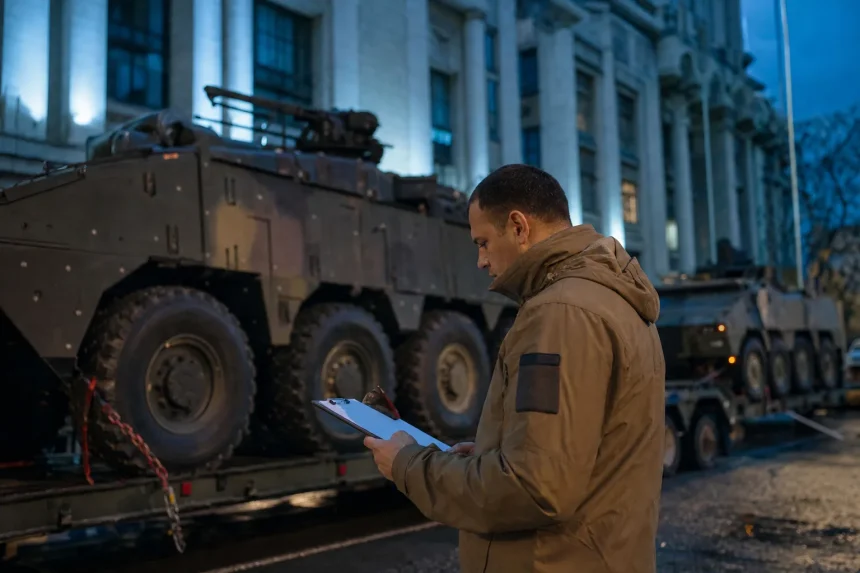
Romania’s Minister of National Defence, Radu Oprea, has sent the ministry’s Control Body to DGARM, the directorate responsible for defence equipment procurement, to examine contracts linked to the SAFE programme. Oprea said the review would assess publicly discussed sums, competing offers and the selection of companies. He also said decisions on the companies were taken at the Prime Minister’s Chancellery. The source reports an investigation, not a finding of wrongdoing.
Control body sent to procurement directorate
Oprea announced on Thursday that the Control Body had been sent to DGARM, the specialised structure within the Defence Ministry responsible for procurement, requirements and equipment specifications. He said DGARM normally prepares the tender specifications and manages the public procurement processes. The review will examine SAFE contracts and whether the characteristics requested by the armed services appear in the technical specifications for the equipment to be supplied. Oprea also said inspectors would check whether sums discussed publicly are accurate when compared with potential offers from other competitors. The source reports no completed finding or proven irregularity.
SAFE links equipment purchases to industrial cooperation
The minister distinguished between an equipment procurement contract and an industrial cooperation agreement. According to his explanation, the cooperation agreement comes from the Economy Ministry, while the procurement contract concerns the equipment itself. They are connected by a condition: the equipment cannot be formally accepted until a certificate confirms that the required percentage of industrial cooperation has been completed in Romania. This means a bidder or supplier may face obligations beyond supplying the goods. It also means acceptance depends on evidence that the domestic industrial commitment has been met, rather than on delivery alone.
Minister attributes company choices to prime minister’s office
Oprea said equipment requirements were decided by the Defence Ministry and that the SAFE procurement programme should have been carried out through DGARM. He alleged that responsibility was instead moved from the Defence Ministry and the Interior Ministry to the Prime Minister’s Chancellery. In his account, a working committee there included the two ministries and other Romanian state institutions, and company rankings were decided at the Chancellery. Oprea said ministers from Defence and Economy should have been involved in representing the country’s interests. These are the minister’s claims; the article does not establish that the selection process breached procurement rules.
What the review can establish
The announced review covers several stages that are distinct in a public procurement: defining the armed services’ needs, translating them into technical specifications, comparing potential offers and selecting companies. It also reaches into contract performance through the industrial cooperation certificate required before acceptance. That separation matters because a procurement contract and a cooperation agreement may be handled by different institutions while remaining commercially linked. DGARM is the body described as handling the procurement process, whereas the Economy Ministry is responsible for the industrial cooperation agreement. The Control Body’s conclusions have not been reported.
| Fact | Details |
|---|---|
| Reviewing institution | The Defence Ministry’s Control Body |
| Procurement directorate | DGARM |
| Programme | SAFE |
| Industrial cooperation authority | The Ministry of Economy |
| Decision-making body named by the minister | The Prime Minister’s Chancellery |
| Announcement date | 29 October 2026 |
“I sent the Control Body to DGARM to check the contracts.”
WHY IT MATTERS
The case shows how a public procurement can involve linked agreements and more than one institution. For businesses, the relevant opportunity may include both equipment delivery and a domestic industrial cooperation obligation. For officials, the review highlights the need to distinguish who sets requirements, who runs the procurement and who verifies conditions before acceptance.
Reported from digi24.ro, 2026-10-29. The Tender Wire is published by Otnox.