
Romania’s road infrastructure authority has begun preparatory works to repair land-instability damage on the A10 Sebeș–Turda motorway. The project combines ground stabilisation, reconstruction of affected road elements and traffic management, making it a substantial public-works intervention rather than a routine surface repair.
Technical assessments define the repair package
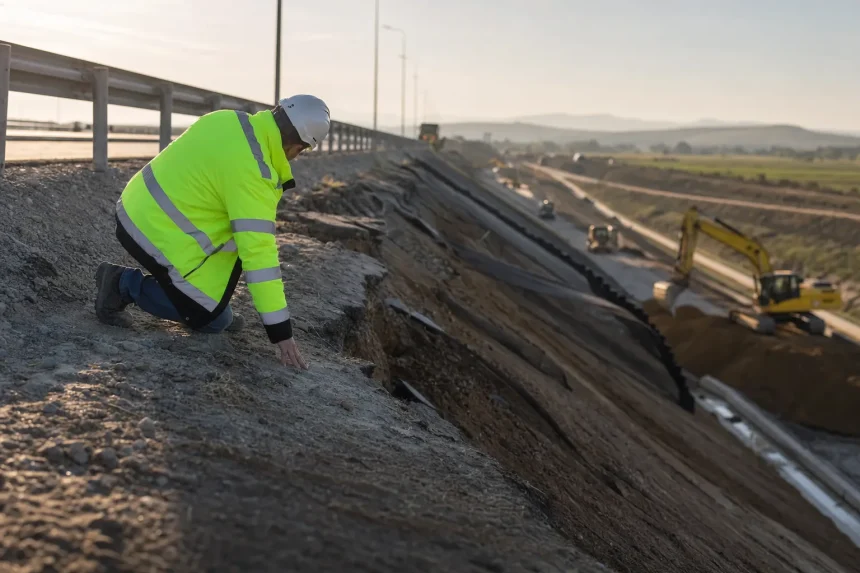
The Compania Națională de Administrare a Infrastructurii Rutiere, or CNAIR, says the permanent remedial works were established on the basis of technical expert assessments. The affected area is on the A10 Sebeș–Turda motorway, between km 66+300 and km 66+500, where land-instability phenomena generated degradation. The planned package covers the foundation ground and embankment, affected earthworks and the motorway body. It also includes the road structure, drainage and water-discharge systems, damaged safety barriers and road signs. The stated objective is to stabilise the ground, strengthen the motorway and remove the causes of the damage.
A contractor-led works programme, with timing still open
The case illustrates a public-works mechanism in which technical assessments establish the engineering response before the physical works are delivered. Here, CNAIR has described a defined package of consolidation and reconstruction measures, while the contractor’s mobilisation will influence how quickly the work proceeds. Weather conditions during the works will also affect the duration. The source does not state the procurement route, contract value or identity of the contractor, so those details cannot be used to assess the award or the level of competition. What is clear is that the repair involves several linked workstreams rather than a single resurfacing operation.
Traffic is being managed around the repair operation
CNAIR has explained its choice to divert traffic onto the DN1 during the A10 repair works. A traffic diversion is a delivery decision that sits alongside the construction package: the road authority must keep movement operating while the affected carriageway or motorway section is being repaired. DRDP Cluj had announced during the summer that traffic was expected to be closed on approximately 17 kilometres of the A10 Sebeș–Turda, on Calea 1, the direction from Unirea to Turda, in Cluj county. The source does not provide further detail on the diversion timetable or its operational justification.
Safety upgrades extend beyond the road surface
The planned intervention shows why damage caused by unstable ground can require a wider procurement scope than replacing visible pavement. CNAIR lists reinforced-concrete piles and injected micropiles for the foundation ground and embankment, followed by reconstruction with granular material reinforced by geogrid. The road structure will then be restored in affected areas, while drainage and water evacuation systems will be repaired and completed. Replacing damaged barriers and restoring road signs are also part of the package. CNAIR says the combined measures are intended to provide safe traffic conditions over the long term, although the completion period remains dependent on mobilisation and weather.
| Fact | Detail |
|---|---|
| Authority | Compania Națională de Administrare a Infrastructurii Rutiere (CNAIR) |
| Motorway | A10 Sebeș–Turda |
| Affected section | km 66+300 – km 66+500 |
| Basis for the works | Technical expert assessments |
| Traffic diversion | DN1 |
| Planned closure | Approximately 17 kilometres on Calea 1, Unirea–Turda |
| Location | Cluj county |
| Duration factors | Contractor mobilisation and weather conditions |
The interventions aim to stabilise the ground, strengthen the motorway body and eliminate the causes that generated the degradation.
WHY IT MATTERS
Remedial road procurement can combine geotechnical stabilisation, reconstruction, drainage and traffic management in one delivery programme. For bidders and buyers, the scope shows how technical assessments can shape the works requirement, while mobilisation and weather remain practical factors in delivery.
Reported from economica.net, 2026-11-03. The Tender Wire is published by Otnox.