What does the Mihăileni dispute show about the link between environmental authorisation, public funding and the management of major water infrastructure?
A stalled project and a ministerial allegation
Environment, Water and Forests Minister Natalia Intotero has criticised the management of the Mihăileni dam project by the Crişuri-Oradea Water Basin Administration, known as ABA Crişuri-Oradea. Speaking in Deva, she said the administration had done nothing since a court ordered the works to stop and called the situation a “bătaie de joc”, or mockery. Those are the minister’s allegations about project management, not an established finding of misconduct. The source reports no audit outcome or procurement ruling against ABA Crişuri-Oradea. The works were halted after a final Court of Appeal in Cluj ruling on 16 February, in a case brought by an environmental association, concerning discrepancies in the environmental approval.
Reauthorisation is the immediate gateway
The mechanism now at issue is regulatory reauthorisation: the minister says the works can be brought into compliance with environmental rules, reauthorised and then funded so construction can continue. In practical procurement terms, that is a project-governance gate before public money can safely support completion; it is not presented in the source as a new contract award or a competition between suppliers. The court ruling removed the project’s construction authorisation, so the public body must address the legal and environmental position before proceeding. Intotero said the process should be accelerated so the required funds can be included in the next state budget.
Funding pressure extends beyond Mihăileni
Intotero linked the dam to a wider concern about Romania’s use of external grants for water infrastructure. She said the state had lost “hundreds of millions of euros” that could have supported rehabilitation works, and that only one dam and one polder had been rehabilitated in Bihor. She also cited Valea de Peşti, whose dam supplies water to 80% of the population of the Jiu Valley. Rehabilitating its asphalt facing is estimated at about 10.5 million euros, which the minister said would have to come from the state budget. The comments underline how delayed authorisation can shift a project from external funding to domestic financing, although the source does not establish why funds were lost.
An infrastructure project nearing completion
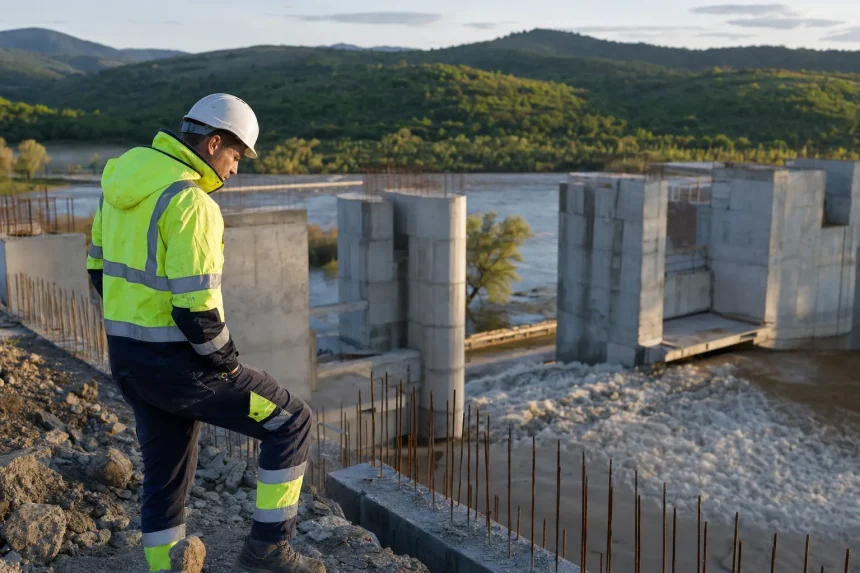
The Mihăileni hydraulic accumulation on the Crişul Alb river is reported to be 90% complete. Work began in 1987, while the reservoir dam, floodwater spillway and operating headquarters were completed in 2022. The project’s main purposes are to supply Brad and downstream communes with water, retain flooding from the slopes and protect local communities from inundation. Its current status therefore affects both a public-service objective and the management of a long-running capital project. The minister said that, if the project is not brought into legal compliance by the end of the year, money cannot be included in the 2027 budget. The source gives no completion timetable after reauthorisation.
IN NUMBERS
The Mihăileni case illustrates why public infrastructure cannot be assessed only by physical progress. A project may be largely built yet unable to proceed when its construction authorisation has been removed. For buyers and bidders, the immediate lesson is that environmental approvals, court decisions and budget authority can be conditions for delivery alongside the works contract itself. In this case, the minister has called for possible audit scrutiny, but no audit has been reported and no wrongdoing has been proven.
Reported from economica.net, 2026-11-06. The Tender Wire is published by Otnox.