
Ghana’s National Anti-Illegal Mining Operations Secretariat (NAIMOS) says it will work with the sector ministry to revise measures against illegal sand winning after an enforcement operation exposed extensive environmental degradation in parts of the Greater Accra Region. The proposed response places coordinated enforcement, rather than action by a single agency, at the centre of the next phase.
A revised response follows visible land damage
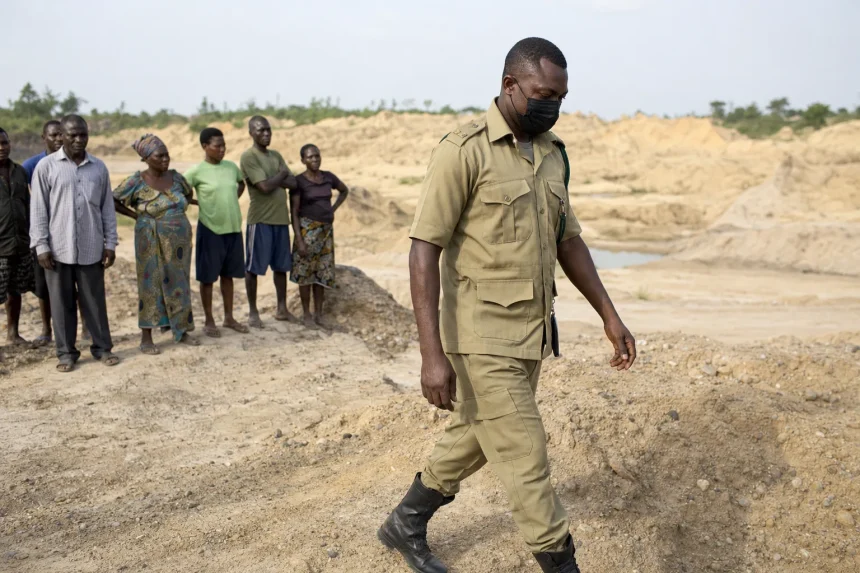
The latest operation uncovered widespread land destruction attributed to unregulated sand extraction in the Greater Accra Region. NAIMOS said the damage raised concerns about environmental consequences and effects on nearby communities, while residents of Afienya had already complained about the continued activities of sand winners. Paa Kwesi Schandorf, a spokesperson for the Secretariat, said NAIMOS and the sector ministry would urgently review existing measures and introduce interventions intended to prevent further destruction. He described illegal sand winning as another threat to Ghana’s fragile environment and said the country could not afford another environmental crisis. The proposed measures remain under development; the source does not identify their legal form, enforcement powers or implementation timetable.
The mechanism is joint design followed by enforcement
NAIMOS’s approach is to revise the response with the sector ministry before introducing new interventions. That matters because enforcement can fail when agencies act without a shared basis for action, responsibilities or operating method. The source presents the proposed review as an urgent administrative step, not as a completed procurement or a new contract award. For organisations involved in public enforcement, the transferable mechanism is coordinated preparation: the lead secretariat and ministry develop the measures, while operational agencies apply them. NAIMOS says the revised measures are expected to strengthen efforts against illegal sand extraction and prevent further environmental degradation, but no detailed procedure has yet been published.
Police call for Minerals Commission coordination
Daniel Dan Yaro, commander of the Sege District Police Headquarters, called for closer collaboration between the Minerals Commission and security agencies. He said enforcement should be conducted professionally to prevent excesses and ensure that those at the forefront understand the basis for the exercise. Yaro also said nobody should be intimidated, linking collaboration to a clearer understanding of the activity’s basic principle. His request makes coordination part of the enforcement issue itself: the Minerals Commission is expected to work effectively with security agencies so that joint action can reduce illegal sand winning. The comments do not establish that any officer or operator has committed wrongdoing.
Community concerns are driving attention to the issue
The operation followed concerns raised by residents of Afienya about sand winners and the effects of their activities on local communities. Residents spoke to JoyNews reporter Stephen Mensah during the latest enforcement exercise, adding local accounts to the environmental concerns identified by NAIMOS. The Secretariat’s warning connects the sand-winning issue with Ghana’s wider struggle against illegal mining, which Schandorf said had already ravaged the country. That comparison explains the urgency of the proposed review, while stopping short of proving that every sand-winning activity is illegal. The source refers specifically to illegal or unregulated extraction and reports no findings against named businesses.
| Fact | Details |
|---|---|
| Lead agency | National Anti-Illegal Mining Operations Secretariat (NAIMOS) |
| Proposed action | NAIMOS and the sector ministry will revise existing measures |
| Affected region | Greater Accra Region |
| Community named | Afienya |
| Police command | Sege District Police Headquarters |
| Coordination requested | Minerals Commission and security agencies |
| Report date | 6 November 2026 |
“We need to do things professionally to avoid excesses so that at least those who are in the forefront can also understand the basis for this enforcement.”
WHY IT MATTERS
The case illustrates an enforcement model based on shared planning and operational coordination. NAIMOS and the sector ministry are to revise measures, while the Minerals Commission and security agencies are being urged to work together. For public-sector buyers and suppliers, the wider lesson is that clear roles, professional conduct and an understood basis for action are part of effective oversight, even before a revised procedure is published.
Reported from myjoyonline.com, 2026-11-06. The Tender Wire is published by Otnox.