
A partnership between Salvați Copiii România, Mastercard and Banca Transilvania has combined medical-equipment purchases, healthcare-facility renovations, neonatal follow-up and staff training. Announcing results one year after launch, the partners said the programme is intended to strengthen care for premature and at-risk newborns during hospital treatment and after discharge.
Equipment and renovation are being delivered across seven units
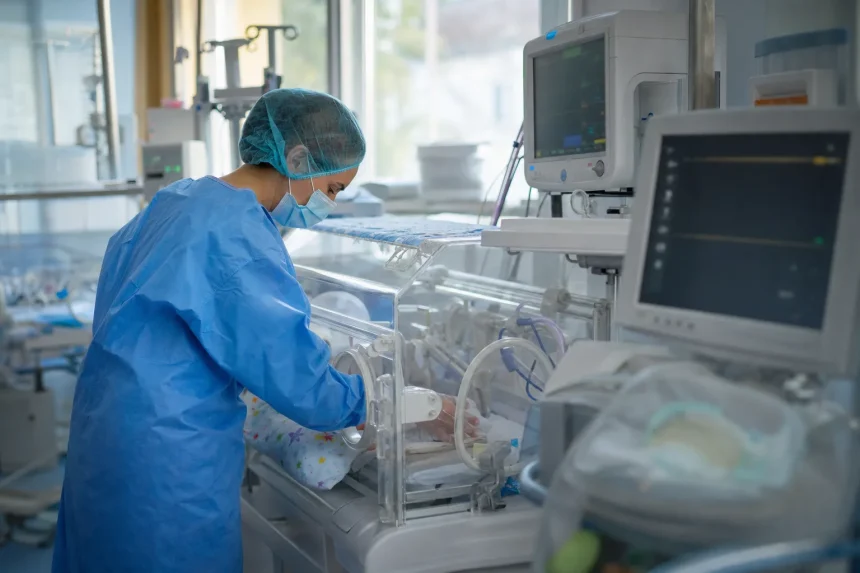
The programme, called “Susținem cele mai grele începuturi”, has supported the modernisation and fitting-out of five centres that monitor premature and at-risk newborns, as well as equipment purchases and renovation works in seven healthcare units. The partners estimate that donated equipment will contribute annually to the care of more than 4,000 newborns, while the five centres will be able to monitor about 1,000 at-risk children each year. The announcement does not present this as a single standard specification: acquisitions and works were adapted to the needs identified at each beneficiary hospital.
A partnership model matches purchases to clinical needs
The project illustrates a procurement route in which external partners support healthcare facilities through a defined programme rather than applying one equipment package to every site. At Cluj-Napoca, the neonatal departments received an ultrasound scanner, two ventilators, a neonatal resuscitation platform, two positioning kits for premature babies and an ultrasound software update. Gherla received five newborn cots, a pulse oximeter and an infusion pump. Other sites received items including laryngoscopy sets, an aEEG monitor, a vein-visualisation device and equipment for monitoring newborns. The source does not specify a tender procedure or the suppliers involved.
The programme extends beyond the maternity ward
Its second and third elements are digital monitoring after discharge and continuing education for medical staff. The partners plan a digital platform for following children after they leave hospital, alongside training for about 100 healthcare workers. Neonatal follow-up covers the period from discharge from the maternity unit until a child reaches the corrected age of two, according to the programme description. Five centres provide this service in Cluj-Napoca, Bucharest, Iași, Timișoara and Târgu Mureș. Renovation works included replacing windows and doors, renewing floors and modernising sanitary facilities where required, alongside specialised furniture and medical equipment.
Cluj illustrates the pressure on specialist services
Claudia Gherman, manager of Cluj County Emergency Clinical Hospital, said the hospital received investments of 300,000 euros through the project. Clinicians described the hospital as receiving complex cases from north-western Romania and said it takes patients from other areas. Gabriela Zaharie, head of Neonatology Clinic I, said the hospital’s smallest patient had been born at 22 weeks and weighed 430 grams. The programme’s supporters and hospital representatives presented the investment as complementing state, health ministry and university support, while noting that medical-system needs remain substantial.
| Fact | Detail |
|---|---|
| Programme partners | Salvați Copiii România, Mastercard and Banca Transilvania |
| Healthcare units receiving equipment or works | Seven |
| Monitoring centres | Five |
| Estimated newborns reached annually by donated equipment | More than 4,000 |
| Estimated children monitored by the five centres annually | About 1,000 |
| Investment reported at Cluj County Emergency Clinical Hospital | 300,000 euros |
The programme combines tailored equipment and renovation with monitoring after discharge and continuing medical education.
WHY IT MATTERS
For healthcare buyers and bidders, the programme shows how a multi-site support scheme can combine site-specific medical equipment with renovation, digital follow-up and staff training. The source provides the beneficiary units and examples of goods and works, but does not set out a public tender, award process or supplier list.
Reported from economedia.ro, 2026-11-11. The Tender Wire is published by Otnox.