

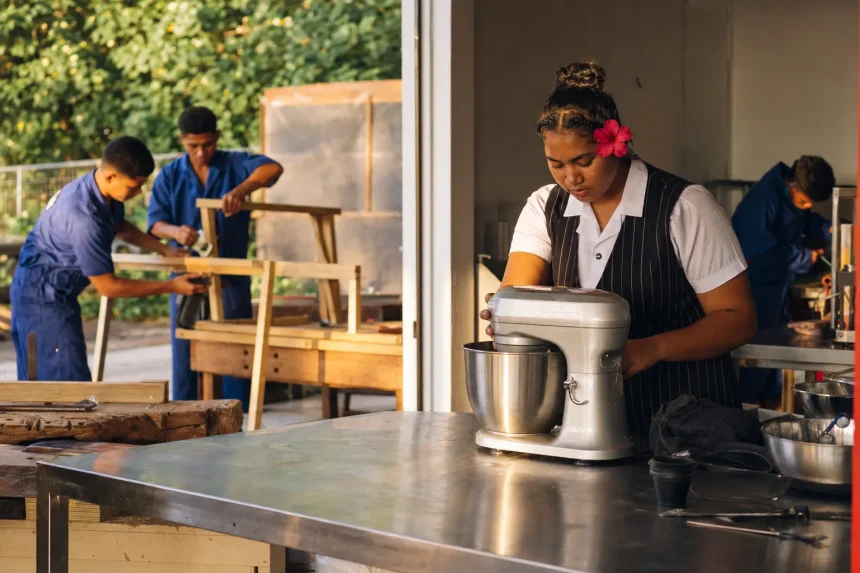
Students and trainees at Don Bosco Technical Centre and Laumua o Punaoa Methodist Technical Centre are receiving new equipment, tools and upgraded learning facilities through Australian Government support. The investment shows how public funding can be channelled through a skills programme and training providers to improve both physical resources and the capability needed to use them effectively.
A partnership built around training providers
The support is being delivered through Pacific Australia Skills rather than presented as a standalone purchase of equipment. The programme works with training providers on facilities and tools while also supporting accreditation, curriculum and course development, quality assurance, and trainer and assessor capability. That makes the arrangement relevant beyond the initial investment: public funding is being linked to the way courses are designed, taught and checked. For businesses bidding for similar work, the model illustrates how a government-backed skills intervention can involve several connected deliverables, with the training provider remaining central to deciding how resources respond to students, trainers and industry.
Equipment intended to reflect workplace standards
At both centres, learners are gaining access to modern, industry-relevant equipment and improved learning environments intended to better reflect workplace standards and requirements. At Don Bosco, the investment also supports a training approach that gives equal importance to knowledge, practical skills and the attitudes students take into employment. Father Bernard Graham said the value extends beyond the machinery itself, arguing that students must understand how to use their knowledge and how to conduct themselves at work. In hospitality, he said, that includes recognising that the job involves welcoming people and sharing a human experience, not simply providing a service.
A wider benefit across trades and employers
The project is also being used to connect different fields within Don Bosco. Construction students contributed woodwork for the hospitality area, allowing learners from separate disciplines to contribute to one another’s work. Meg Somers, Second Secretary Political/Economic for the Australian High Commission in Samoa, said practical, industry-relevant equipment can build confidence and workplace skills while helping prepare students for employment and future opportunities. She added that upgraded resources give trainers stronger tools for hands-on learning and help employers by contributing to a pipeline of graduates better prepared for workplace expectations.
What the funding arrangement demonstrates
The investment demonstrates a partnership between government, training providers and development partners, with improvements aimed at quality, accessibility and industry relevance across Samoa’s TVET system. It also shows why facilities spending is only one part of a public skills intervention. The equipment has value when trainers can use it, courses and accreditation support it, and learners practise in environments connected to employment. Pacific Australia Skills describes the wider objective as creating pathways for more Samoans to gain the skills needed for meaningful and sustainable employment, while supporting Samoa’s national development priorities.
| Fact | Detail |
|---|---|
| Country | Samoa |
| Training centres | Don Bosco Technical Centre and Laumua o Punaoa Methodist Technical Centre |
| Funding government | Australian Government |
| Delivery programme | Pacific Australia Skills |
| Investment | New training equipment, tools and upgraded training facilities |
| Skills system | Technical and Vocational Education and Training |
The resources are important, but the real investment is in the people who will use them.
WHY IT MATTERS
For public buyers and providers, the transferable lesson is that investment in training facilities can be specified as more than a supply of equipment. The Samoa initiative connects resources with curriculum, accreditation, quality assurance and trainer capability, while keeping industry relevance and learner outcomes in view.
Reported from talamua.com, 2026-09-21. The Tender Wire is published by Otnox.