

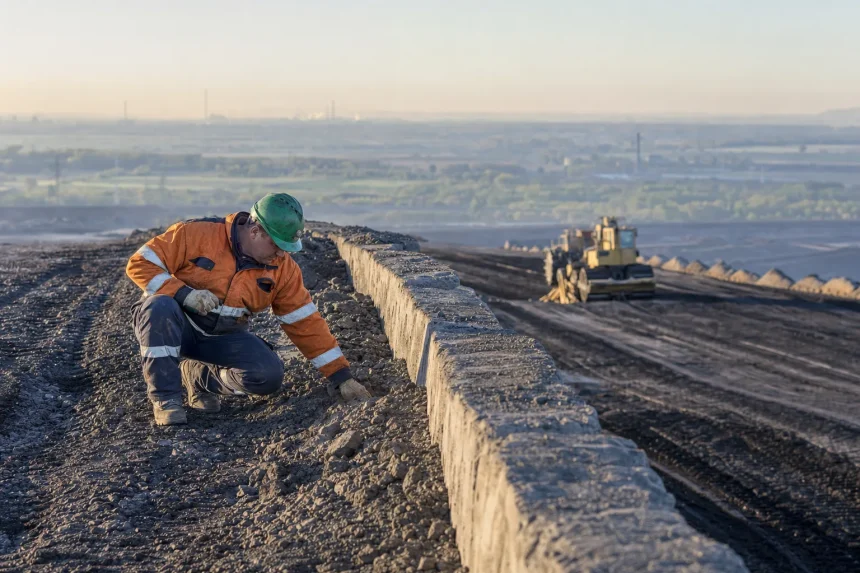
A Czech environmental case involving suspected construction waste at Ostrava’s Heřmanice spoil heap has been closed without a finding of liability. The decision has raised questions about how the Ministry of the Environment handled evidence and the submission of the company under investigation.
A case transferred from the inspectorate
The Czech Environmental Inspectorate had investigated whether Ridera Bohemia placed hundreds of thousands of tonnes of construction waste in a separation wall at the Heřmanice heap. The company was contracted by state enterprise Diamo to fill a 440-metre-long, 40-metre-wide trench with aggregate and other approved materials. A control found concrete, wood, plastics and cables in the heap. In April, the Ministry of the Environment took the administrative case from the inspectorate and decided it would rule on the matter itself. Ridera had requested the transfer, alleging that the inspectorate had ignored evidence favourable to the company, missed deadlines and declined to hold an oral hearing with experts.
Decision repeated passages from Ridera submission
On 1 July, ministry official Tomislav Střelec ended the case, saying the investigation had not produced hard evidence of unlawful conduct. His twelve-page decision rejected photographs supplied by Diamo, saying most lacked a scale and that some could not be verified as to when or where they were taken. Seznam Zprávy reported that at least seven passages were identical or closely similar to Ridera’s submission, including the criticism of the photographs, a reference to the same case law and the conclusion that the evidence did not prove liability beyond reasonable doubt. The matching passages reportedly included punctuation errors. No wrongdoing by Střelec or the ministry has been established.
The ruling removed a potentially costly obligation
Ridera had denied responsibility from the beginning. The July decision removed the threat of a fine and a potentially larger financial consequence: if found liable, the company might have had to remove the waste, at an estimated cost of about a billion. Ridera’s media representative, Eva Kijonková, said the company had submitted statements and legal arguments as is normal in such proceedings, and that the way the ministry later drafted its decision could not be the company’s responsibility. Střelec referred questions about the copied passages to the ministry’s press office. The ministry did not explain why the wording matched the company’s submission.
Why the procedure matters
The case illustrates the difference between an administrative offence proceeding and a criminal investigation. Police examined the Heřmanice heap from 2023 and later concluded that no criminal offence had been committed, passing suspicions of an administrative offence to the inspectorate. The ministry then became the deciding authority after taking the case from that inspectorate. In such a proceeding, the authority must assess whether the available evidence reliably establishes the alleged breach; the decision cited the principle that doubts must benefit the accused. The ministry has not officially published the ruling. After an information request, it used a longer environmental-law timetable and extended it by a further 30 days, citing the need to obtain a position from criminal-law authorities.
| Fact | Details |
|---|---|
| Location | Heřmanice heap, Ostrava |
| Company | Ridera Bohemia |
| State contractor | Diamo |
| Separation wall | 440 metres long and 40 metres wide |
| Decision date | 1 July |
| Estimated removal cost | About a billion |
No evidence, the ministry said, proved Ridera’s liability beyond reasonable doubt.
WHY IT MATTERS
When a public authority takes an enforcement case from a specialist inspectorate, the transfer makes the authority’s handling of evidence and reasoning especially important. Reusing a party’s arguments is not itself proof of an unlawful decision, but unexplained similarities can affect confidence in the independence and transparency of the process.
Reported from seznamzpravy.cz, 2026-09-25. The Tender Wire is published by Otnox.