

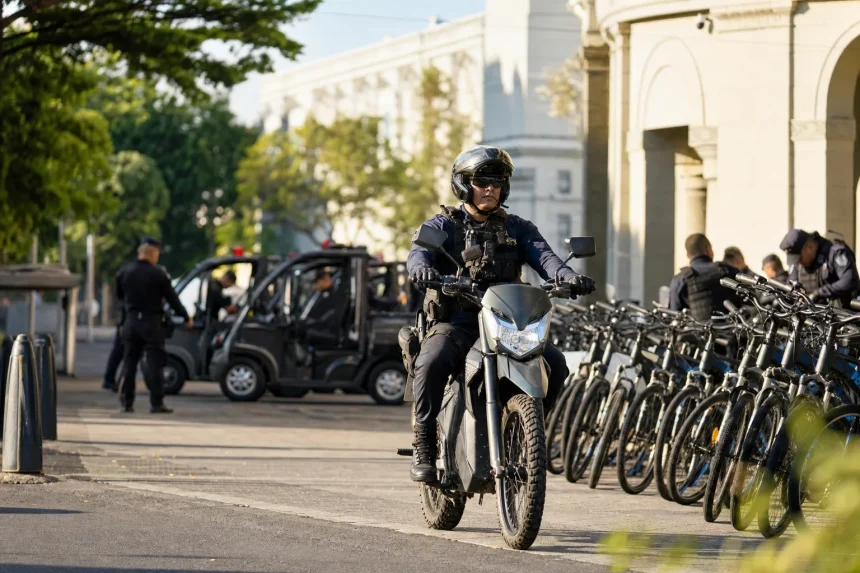
El Salvador’s Ministry of Public Security and Justice has presented a new fleet of 364 electric vehicles for the National Civil Police. The vehicles are intended for operational work in San Salvador’s Historic Centre, the international airport, Greater San Salvador and La Libertad.
A mixed fleet for several operating environments
The delivery includes pick-ups, panel-type vehicles, motorcycles and bicycles, giving the police a range of vehicle types for different duties and locations. Units will be used in San Salvador’s Historic Centre, at the international airport, in Greater San Salvador delegations and in the department of La Libertad. The Historic Centre is expected to receive electric mobility ranging from bicycles to utility vehicles and pick-ups. Some motorcycles will also be distributed to delegations in Greater San Salvador and La Libertad, while the airport allocation is linked to a new airport police delegation under construction.
The procurement forms part of a longer programme
Public Security and Justice Minister Gustavo Villatoro said the police began adding electric mobility in 2021, when the institution purchased its first 65 electric motorcycles. The police now reports having more than 200 electric motorcycles, alongside the newly presented fleet. The source does not identify the purchasing route, suppliers, contract value or award method. In procurement terms, the delivery is a purchase of operational goods by a public institution: the buyer’s requirements can cover vehicle types, intended locations, performance and energy use, while the competition and contract details would depend on the procedure used.
Energy infrastructure supports the fleet
The ministry and the National Civil Police have installed more than 2.2 million watts of solar energy at more than eight locations. That infrastructure is presented alongside the electric fleet, indicating that the vehicle programme is being developed with charging and energy provision in mind. Villatoro said the vehicles include sensors that contribute to more efficient driving. He also said electric vehicles reduce polluting emissions and improve efficiency in police deployment. Those are the ministry’s stated benefits; the report provides no independent measurement of emissions, operating costs or vehicle performance.
What buyers and bidders can take from the case
A vehicle fleet purchase illustrates why public buyers may specify a complete operating requirement rather than only a vehicle model. The requirement can involve the mix of vehicles, where they will work, the equipment needed for efficient operation and the energy arrangements supporting them. For bidders, that can make delivery, technical capability and compatibility with existing infrastructure material parts of a proposal. Here, however, the available account confirms the fleet and its intended uses but does not say whether the vehicles were bought through an open competition, a framework, a direct award or another mechanism.
| Fact | Value |
|---|---|
| Electric vehicles presented | 364 |
| First electric motorcycles added | 65 in 2021 |
| Electric motorcycles already reported | More than 200 |
| Solar energy installed | More than 2.2 million watts |
| Solar energy locations | More than eight |
| Intended users | National Civil Police |
| Main deployment areas | Historic Centre, international airport, Greater San Salvador and La Libertad |
The new fleet seeks to expand the mobility capacity of police teams in different parts of the country.
WHY IT MATTERS
Fleet procurement is also infrastructure procurement. Vehicle specifications, operating locations, sensors and energy supply can shape the competition and determine whether a purchase works beyond the handover.
Reported from infobae.com, 2026-09-10. The Tender Wire is published by Otnox.