
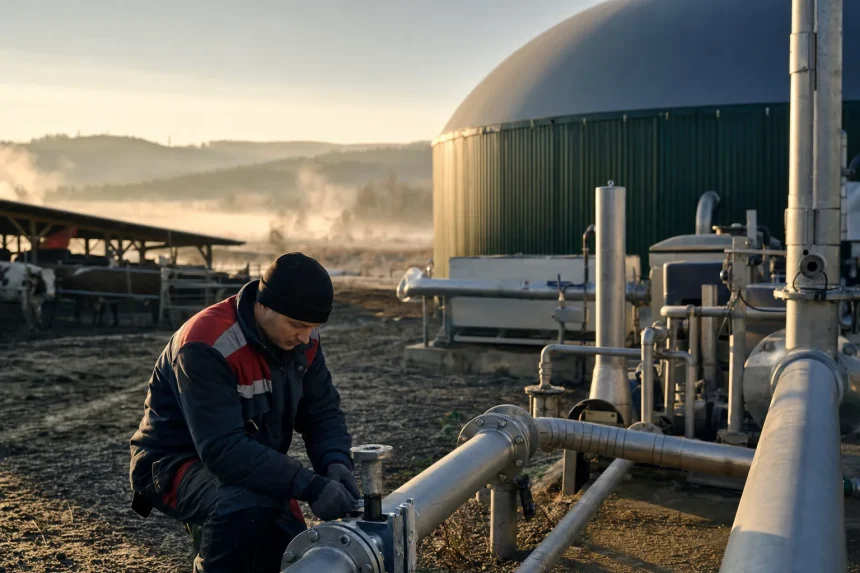
Four manure-based biogas stations financed through Romania’s National Recovery and Resilience Plan have been completed, marking a significant phase of publicly supported investment in farm energy and waste management. The projects belong to companies active in livestock farming and cereal cultivation, and are recorded with 100% technical progress on the public platform of the Ministry of Investments and European Projects.
Public funding has supported four completed projects
The four completed stations received a combined €11 million from the PNRR. The largest award, €3.4 million, went to Abatorul Doripesco pentru Procesarea Cărnii Cooperativă Agricolă, part of the Doripesco group in Braşov. Panifcom in Iaşi received €2.99 million, Agrocomplex Lunca Paşcani €2.98 million, and Agro-Chirea in Olt county €1.78 million. In December 2025, five companies appeared on the funding list, with projects worth more than €14 million. Genesis Bio 4, owned by Genesis Biopartner, was then listed with a €3.35 million project in Ialomiţa, but no longer appears on the current platform.
The mechanism is grant finance, not a conventional purchase
This activity illustrates a grant-funded procurement route: public money supports companies’ capital projects, while the beneficiaries build and operate the assets rather than supplying a service bought directly by a public authority. The public platform records technical progress, but the companies remain responsible for delivery, operation and any contribution beyond the grant. At Agrocomplex Lunca Paşcani, the investment was budgeted at €4.5 million. Director general Bogdan Pantazi said savings were made during execution, but exchange-rate movements meant the company had to provide a larger own contribution while the PNRR funding remained unchanged.
Farm operations determine whether the investment works
At Agrocomplex Lunca Paşcani, construction began in the autumn of the previous year. The station has a maximum capacity of 630 kilowatts and was nearing that production level after testing. It temporarily stopped exporting electricity to the grid while documents were obtained, with deliveries due to resume on 14 October. Feedstock comes from the company’s own farm and a partner farm. Panifcom’s station at Broşteni, in Vlădeni commune, has a capacity of 1,000 kilowatts and is designed to use up to 20,000 tonnes of cattle manure a year. At Crizbav, Doripesco’s station is expected to process 82 tonnes of feedstock a day.
The wider value lies in the circular model
The projects are intended to manage manure while producing energy and using the resulting heat and digestate. At Agrocomplex, digestate is described as more thoroughly fermented and stabilised manure that can replace part of the chemical fertiliser requirement. Pantazi said the investment was not expected to generate exceptional profit, but primarily addressed environmental needs and could reduce farm costs or create additional income. Agrocomplex works almost 3,000 hectares of arable land and has an average annual herd of 1,700 dairy and beef cattle, plus a similar number of sheep. The company had studied biogas installations for almost 20 years before securing support.
| Fact | Value |
|---|---|
| Completed stations | Four |
| PNRR funding | €11 million |
| Largest award | €3.4 million |
| Agrocomplex station capacity | 630 kilowatts |
| Panifcom station capacity | 1,000 kilowatts |
| Doripesco daily feedstock | 82 tonnes |
The secret consists in integrating all the activities.
WHY IT MATTERS
Grant-funded infrastructure can help agricultural businesses combine waste management, energy production and fertiliser use. For bidders and public buyers, the projects also show how delivery depends on both the funded construction work and the beneficiary’s ability to integrate the asset into its existing operations.
Reported from zf.ro, 2026-10-13. The Tender Wire is published by Otnox.