

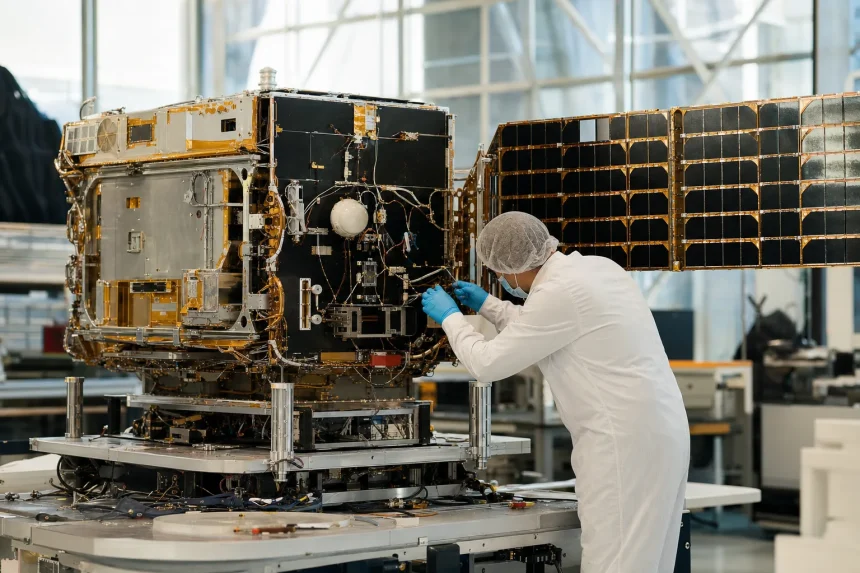
GHGSat has awarded SFL Missions a contract to develop GHGSat-D2, a demonstration satellite intended to improve the accuracy and frequency of greenhouse gas measurements from orbit. The project combines a larger spacecraft platform, a new sensor supplied by ABB Canada and enhanced systems for pointing, propulsion and data collection.
A supplier award for a larger spacecraft
SFL Missions Inc. has been selected by GHGSat of Montreal to develop GHGSat-D2, which is designed to support more accurate and frequent measurements of emissions from sources on the Earth’s surface. The satellite is being built around SFL Missions’ expanded DEFIANT-XL bus to accommodate a larger, higher-accuracy sensor manufactured by ABB Canada. Its completed mass is expected to be just under 100 kg at launch. That is substantially larger than the SFL NEMO microsatellite bus used for the GHGSat “Claire” Pathfinder mission in 2016 and for 11 commercial emissions-monitoring satellites launched since then, which averaged 15 kg. SFL Missions is also building GHGSat-C18 and -C19 on its NEMO bus in Toronto.
What the contract is buying
The mission is intended to improve the ability to pinpoint and measure methane emissions from smaller sources on the ground. SFL Missions says the satellite will use the latest version of its Attitude Determination and Control System, combining onboard software and hardware to maintain stability in orbit and point the sensor precisely at targets. GHGSat-D2 is expected to detect emissions as low as 50 kg/hr from space, while daily coverage per satellite will double to 20,000 km2. The satellite will also be able to slew up to 45 degrees across and along its orbit path, increasing how often it can capture data over a particular location, a capability known as revisit rate.
A commercial award with public-sector relevance
The source describes a contract between GHGSat and SFL Missions, rather than a government procurement or a tender process. That distinction matters: the announcement identifies the buyer, supplier and technical requirements, but does not set out how competing offers were assessed or whether a public authority was involved in the award. GHGSat says customers in government and industry use its data across oil and gas, power generation, mining, waste management and agriculture. The project is therefore relevant to public procurement because public bodies may rely on the resulting environmental data, while the award itself is presented as a commercial supplier relationship.
Design changes extend the mission’s reach
The DEFIANT-XL bus will accommodate two star trackers rather than one, supporting precision pointing from any slew orientation in orbit. GHGSat-D2 will also include propulsion to extend its operational life, giving it the ability to avoid collisions with other satellites and counter orbital drag caused by solar activity. Deployable solar panels are being incorporated to supply power for the larger sensor and additional subsystems. SFL Missions says its selection reflects the reliable attitude control and target-tracking capabilities of its platforms. The company reports 98 operationally successful missions and more than 470 cumulative years in orbit, while 33 satellites are now under development at its Toronto facility.
| Fact | Detail |
|---|---|
| Buyer | GHGSat of Montreal |
| Supplier | SFL Missions Inc. |
| Satellite | GHGSat-D2 demonstration satellite |
| Expected launch mass | Just under 100 kg |
| Detection capability | Emissions as low as 50 kg/hr |
| Daily coverage | 20,000 km2 per satellite |
| Maximum slew | 45 degrees across and along the orbit path |
“Now, with our second-generation constellation, we’re building on that success to unlock a substantial leap in performance,” said Stephane Germain, GHGSat CEO.
WHY IT MATTERS
The award shows how a specialist supplier relationship can be structured around measurable mission requirements, including sensor capacity, pointing accuracy, coverage, revisit rate and spacecraft life. The announcement does not describe a public tender, but the resulting data is intended for customers in government and industry.
Reported from financialpost.com, 2026-09-28. The Tender Wire is published by Otnox.