
Mexico’s Instituto Mexicano del Seguro Social has started distributing a first package of high-technology medical equipment, linking a wider acquisition plan to needs identified by staff in hospitals and medical units.
First dispatch covers three equipment categories
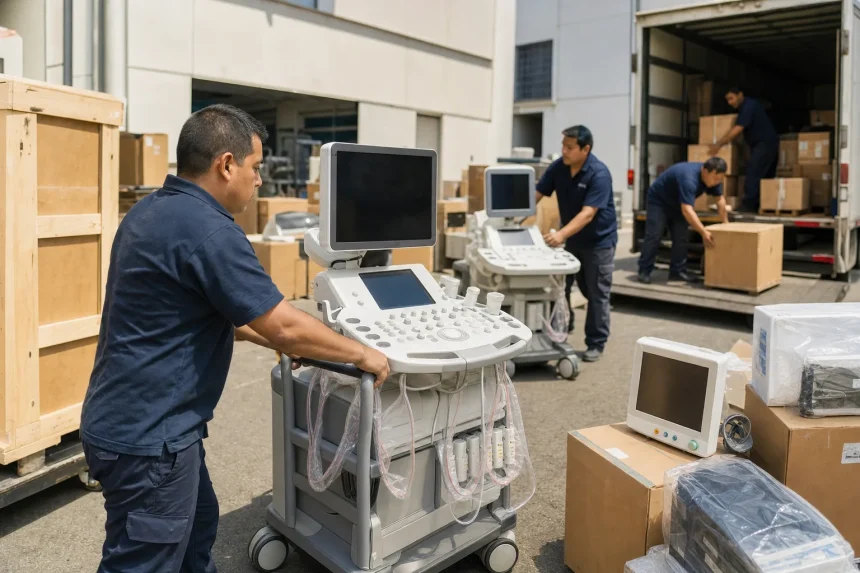
Zoé Robledo, director general of the Instituto Mexicano del Seguro Social, led the dispatch from the Vallejo Central Warehouse. The first package contains 47 specialised items for 39 hospitals in 19 states: 20 ultrasound machines with 3D visualisation, 17 electrocardiographs for emergency departments and 10 multiparameter vital-sign monitors for intensive care units. The equipment is part of the 12 Actions in 120 Days plan, presented three days before the dispatch, and represents its fifth action. The devices arrived at the central warehouse a day earlier and distribution to the beneficiary medical units began immediately.
Allocation followed requests from hospital staff
The IMSS said the destination of the equipment was based on needs identified during supervisory visits and direct discussions with staff in medical units. Robledo said the allocation was not decided solely in an office, but followed a floor-by-floor listening exercise involving doctors, nurses, technicians and other personnel. The account illustrates a procurement and distribution chain in which operational needs inform where already-acquired equipment is sent. Among the beneficiaries are hospitals in Chihuahua, Jalisco, Morelos, Nuevo León, Oaxaca, Hidalgo, Sonora, Tamaulipas, Quintana Roo, Estado de México, Coahuila and Guanajuato, among other states.
The wider acquisition includes 2,917 devices
The first delivery is an initial step in a broader institutional acquisition of 2,917 medical devices under the plan. The source does not specify the tender method, suppliers, contract values or award criteria, so the announcement describes the equipment’s acquisition and deployment rather than a complete contracting procedure. It does, however, show how a public buyer can connect purchasing decisions with service-level requirements: emergency departments receive electrocardiographs, intensive care units receive vital-sign monitors, and a hospital in Veracruz Norte expects its new high-end ultrasound to expand maternal-fetal, vascular and musculoskeletal diagnostic capacity.
Hospitals report long-standing equipment needs
The receiving hospitals described practical reasons for the deliveries. Daniel Carmona González, director of General Hospital of Zone No. 71 in Veracruz Norte, said the ultrasound has a high-frequency transducer for maternal-fetal studies and a linear transducer for vascular and musculoskeletal examinations. Itzel Guadalupe Villagrán Maldonado, director of General Subzone Hospital No. 17 with Family Medicine in Anáhuac, Chihuahua, said that unit had been managing the request for an electrocardiograph for more than five years. The examples place the first dispatch within a longer effort to address equipment gaps identified by local medical teams.
| Fact | Detail |
|---|---|
| Institución | Instituto Mexicano del Seguro Social |
| First package | 47 specialised medical devices |
| Hospitals covered | 39 hospitals |
| States covered | 19 states |
| Ultrasound machines | 20 with 3D visualisation |
| Electrocardiographs | 17 for emergency departments |
| Vital-sign monitors | 10 for intensive care units |
| Wider acquisition | 2,917 medical devices |
The destination of the equipment was based on needs identified during supervisory visits and direct discussions with staff in medical units.
WHY IT MATTERS
The initiative connects a central acquisition programme with equipment requirements recorded by hospital personnel. For suppliers and public buyers, the announcement shows the distinction between procuring equipment and deciding how, where and when it is deployed; the source gives no details of the tender method or contracts.
Reported from eleconomista.com.mx, 2026-10-30. The Tender Wire is published by Otnox.