


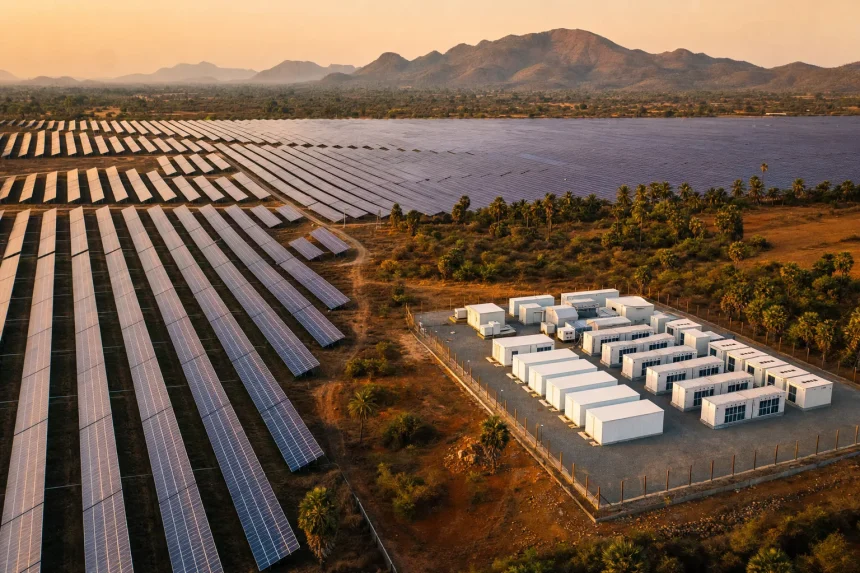
On 27 July the Kerala State Electricity Regulatory Commission approved a power sale agreement between the Kerala State Electricity Board and the Solar Energy Corporation of India. The order, signed by Chairman T. K. Jose and Member B. Pradeep, covers 200 MW of solar paired with a 100 MW, 400 MWh storage system, procured under SECI’s inter-state transmission tranche. The generation itself will sit in Jamnagar, in Gujarat, roughly two thousand kilometres from the state buying it, and comes from Welspun Renewable Energy through a special purpose vehicle. The agreement runs for twenty-five years.
The number that justifies it
The tariff is ₹2.86 per unit. During the proceedings the board told the commission that buying power on the exchanges during peak periods often costs it around ₹9 per unit. That is the whole argument in one line: a state with a sharp evening peak and limited local generation is trading the option to buy cheap on a good day for the certainty of not buying dear on a bad one. The storage component is what makes the comparison legitimate — solar alone does not cover an evening peak, and 400 MWh of batteries is what turns a daytime resource into a dispatchable one.
What a 25-year commitment actually settles
Twenty-five years is longer than the useful life of most of the equipment involved, and far longer than any forecast of what renewable generation will cost. The buyer is not predicting that ₹2.86 will look good in 2040; it is deciding that predictability is worth more than optionality. That is a defensible position for an essential service and a risky one for a technology whose cost curve has fallen faster than nearly every projection made about it. Both things are true at once, and regulators approving these agreements are the ones who have to weigh them.
The structure is becoming the norm
The shape here — a central agency aggregating demand, running the competitive process and then selling on to state distribution companies under long-term agreements — is how a growing share of Indian renewable capacity is now contracted. It concentrates the tendering expertise in one place and gives developers a creditworthy counterparty, which is why tariffs discovered this way have been low. It also means the competitive event happens once, centrally, and everything downstream is an administrative approval of a price that was already set.
| Approved | 27 July 2026, by the Kerala State Electricity Regulatory Commission |
| Buyer | Kerala State Electricity Board Ltd |
| Seller | Solar Energy Corporation of India, ISTS Tranche XX |
| Generator | Welspun Renewable Energy, via a special purpose vehicle |
| Capacity | 200 MW solar with 100 MW / 400 MWh storage |
| Located | Jamnagar, Gujarat |
| Tariff | ₹2.86 per unit |
| Term | 25 years |
WHY IT MATTERS
Long power purchase agreements are the least discussed and most consequential frameworks in public procurement: they fix a price, a counterparty and a technology for a quarter of a century, and they are approved through regulatory orders rather than announced as contracts. For anyone selling into a market like this, the moment that decides the next twenty-five years is the central agency’s tender, not the state-level approval that follows it.
Reported from the KSERC order of 27 July 2026, as reported by Mercom India, SolarQuarter and Saur Energy, 27 July 2026. The Tender Wire is published by Otnox.