


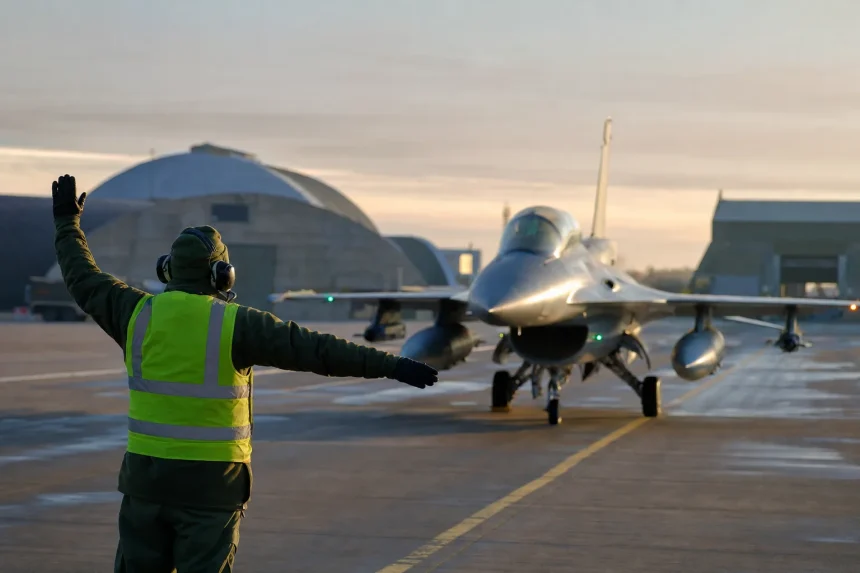
Lithuania is preparing a major upgrade of Šiauliai military air base to support NATO’s air-defence mission and accommodate newer allied aircraft. The planned work includes a runway renovation, additional hangars, strengthened security measures and new aircraft taxiways. The defence minister says the investment will be partly supported through NATO financial instruments.
Infrastructure is being aligned with fifth-generation aircraft
Šiauliai air base is to be adapted for a NATO mission that has moved from air policing towards air defence. The planned works include additional hangars, stronger protective measures and new routes for aircraft moving around the base. The runway, built in 2006, is due for renovation, and the air force base commander says the design discussions have included NATO requirements so that it can support current fifth-generation fighters. The immediate procurement need is therefore broader than resurfacing: facilities, movement areas and security systems must work together as host infrastructure for allied aircraft, including the F-35s now being ordered and received by more NATO members in Europe.
Lithuania is discussing a co-financed investment model
Defence Minister Robertas Kaunas says Lithuania plans to invest between €300m and €400m by 2030 together with NATO financial instruments. A longer-term figure of €800m has been set for Šiauliai air base infrastructure. Negotiations with NATO over funding were described as nearing completion, with the minister saying NATO would provide a substantial share. This points to a co-financing model in which national infrastructure priorities are matched with alliance funding, rather than a single standalone national purchase. For suppliers, the distinction matters: the source describes planned investment and funding discussions, but does not identify contract notices, award methods, bidders or individual package values.
Future aircraft options remain under assessment
The infrastructure plans are linked to a wider discussion about Lithuania’s own military aviation capability after 2030. The minister says the country is considering whether to acquire light attack aircraft, particularly propeller-driven aircraft that could offer comparatively lower cost and flexible take-off and landing options. He says the armed forces are already assessing their capabilities and planning ahead, with a focus on countering drones such as Shahed systems. The report presents this as an evaluation, not a purchase decision. It also records parliamentarian Arvydas Pocius’s view that attack helicopters such as the Apache could be considered, including through a possible wider Baltic or Nordic-Baltic formation.
The base upgrade sits within a wider defence plan
Kaunas links the possible expansion of air capabilities to the completion of Lithuania’s division development plans and to the country’s existing maritime capability plans. He says strengthening air power would be a natural next step. Pocius says NATO previously did not require Lithuania to invest in combat aviation, but argues that the perceived Russian threat is increasing. His comments about Apache helicopters and regional operation with F-35 fighters are political and strategic proposals, not evidence of an approved acquisition. The confirmed procurement-relevant development in the report is the planned investment in Šiauliai infrastructure, while the aircraft choices remain subject to assessment and future decisions.
| Fact | Detail |
|---|---|
| Location | Šiauliai military air base, Lithuania |
| Investment by 2030 | €300m–€400m |
| Longer-term infrastructure investment | €800m |
| Runway | Built in 2006 and planned for renovation |
| Aircraft requirement | Suitable for current fifth-generation fighters |
| Planned works | Additional hangars, strengthened security measures and new aircraft routes |
| Funding status | Negotiations with NATO over funding were nearing completion |
By 2030, we plan to invest between €300m and €400m, together with NATO financial instruments.
WHY IT MATTERS
The project illustrates how defence infrastructure procurement can combine national planning with NATO co-financing. Requirements for allied aircraft may shape runway, hangar, security and airfield-movement packages before any individual contract is published. The report does not yet set out a competition timetable or procurement route.
Reported from lrt.lt, 2026-09-13. The Tender Wire is published by Otnox.