

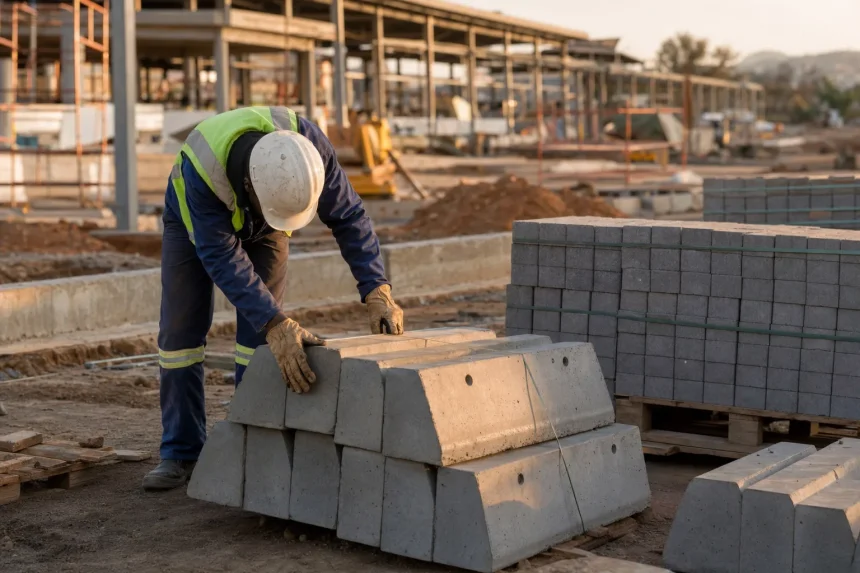
An investigation by the Times of Eswatini SUNDAY found that concrete products used in the Manzini Mall and Bus Rank redevelopment were imported from South Africa, even though Eswatini manufacturers say they can supply comparable precast materials. The finding highlights how project ownership, delivery deadlines and procurement structure can shape opportunities for domestic suppliers.
Imported products identified on the project
The investigation found that some construction material used in the Manzini project was procured from Global Precast, a South African company. Products bearing the Global Precast trademark were identified at Thartia Construction Services, a Matsapha-based company described as the local agent for the South African supplier. The newspaper also identified imported kerbs, pavers and blocks on the project site, sourced from South Africa. Global Precast announced on February 5, 2026 that orders for its products in Eswatini could be placed through Thartia. The finding concerns some materials rather than every input used in the redevelopment. WBHO and Stefanutti Stocks were contacted for comment but had not responded when the report was prepared, so the contractors’ explanation for the purchases has not been established.
Local producers say supply was available
The imports have raised concern among local industry players because precast materials and articles of cement are manufactured at scale in Eswatini. The Eswatini Construction Industry Council’s performance report for the 2023/2024 financial year recorded that one local company, described as arguably the country’s largest concrete block and brick manufacturer, could produce approximately 90 000 to 100 000 pavers and 20 000 blocks per day. Local manufacturers told the newspaper that they expected to benefit from material procurement, particularly because foreign companies dominate the construction industry. They also pointed to permanent jobs, tax payments and spending that circulates through local businesses and households. These claims establish available capacity as an industry argument, not proof that every requested specification, price or delivery requirement could have been met locally.
Project structure leaves procurement questions
The Manzini development was conceptualised as a Public Private Partnership between the municipality, the Eswatini Government and Ntoese Developers. It covers a new Manzini Mall at the Old Trade Fair site, reconstruction of the main bus rank and a bridge across the Mzimnene River, delivered in three phases. However, a source close to the developer and project owner said the current work was privately funded and that the E2 billion project value came from the private developer. The source said the developer was not bound by Eswatini’s procurement laws, while the initial stage had received a government budget of E57 million. That account has not been publicly confirmed by the project parties. Commerce Minister Manqoba Khumalo said his ministry was not involved in procurement, and ESPPRA chief executive Vusi Matsebula said the agency had little to add.
Deadlines and domestic value are competing priorities
The source close to the project said the owner may have preferred companies known to it in South Africa because they could deliver materials on agreed times and prices. The project was said to face strict timelines and penalties for late delivery, with occupancy at 90 per cent. This describes a commercial rationale for sourcing decisions, but it remains an explanation from an unnamed source rather than a response from WBHO, Stefanutti Stocks or the developer. The wider policy issue is domestic value: Public Works and Transport officials said reforms were being developed with the CIC to strengthen Eswatini’s value chain and ensure infrastructure spending brings greater economic benefits. Principal Secretary Thulani Mkhaliphi said imported inputs allowed money borrowed for infrastructure to leave the country, contributing to concerns that jobs were being exported.
| Fact | Details |
|---|---|
| Project | Manzini Mall and Bus Rank redevelopment |
| Imported supplier | Global Precast, South Africa |
| Local agent | Thartia Construction Services, Matsapha |
| Products identified | Kerbs, pavers and blocks |
| Local capacity | Approximately 90 000 to 100 000 pavers and 20 000 blocks per day |
| Project value | E2 billion |
| Initial government budget | E57 million |
Local manufacturers say they have the capacity to supply much of the material needed for projects of this nature.
WHY IT MATTERS
Where a project combines public participation with private funding, the procurement route can determine whether domestic-supplier rules apply. A PPP does not by itself answer which entity buys materials, which funds are being used or what obligations govern the purchase. For bidders and officials, the transferable lesson is to establish the contracting authority, funding source, applicable rules and delivery requirements before assessing whether local capacity should be prioritised.
Reported from times.co.sz, 2026-10-18. The Tender Wire is published by Otnox.