

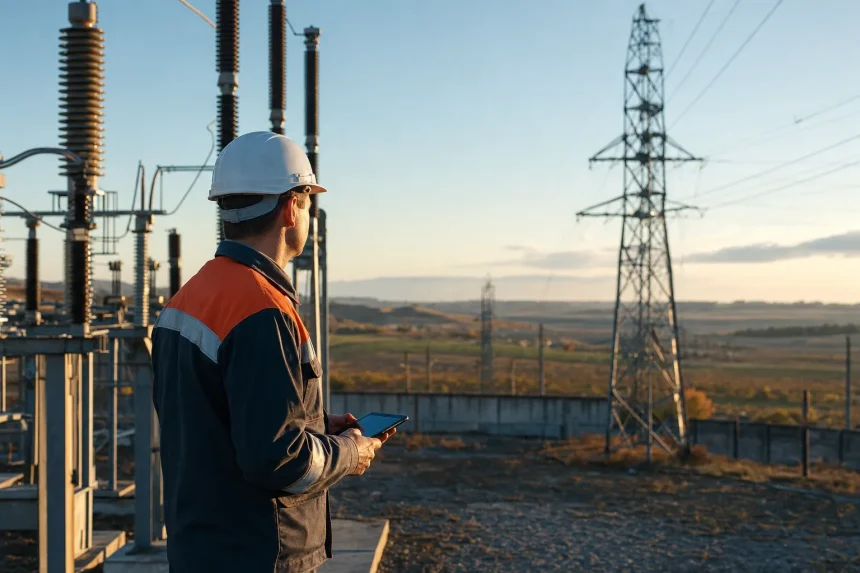
The Moldovan Government has approved a bill intended to accelerate construction of the 400 kV overhead line between Strășeni and Gutinaș, known as the “Trump Liberty Line”. The project would connect Moldova’s electricity transmission network directly with Romania and includes the modernisation and expansion of the Strășeni 330 kV substation.
Public utility status changes the project’s route to delivery
The line and the related Strășeni substation works will be declared public utility projects of national interest if the proposed legislation takes effect. The Government says this status is intended to simplify and speed up procedures needed for construction, including land expropriation and work authorisations. Owners of land affected by the route are to receive expropriation compensation. The arrangement illustrates how a public-interest designation can clear a path for major infrastructure while retaining a compensation process for affected owners. It also shows that an accelerated route does not remove every prerequisite: in areas with archaeological heritage, works may begin only after the necessary archaeological checks have been completed.
A cross-border connection across four districts
The planned overhead line will run for approximately 70 kilometres on the territory of the Republic of Moldova and create a direct connection between the Strășeni substation and Romania’s transmission network through Gutinaș. Its route will cross 25 localities in the districts of Strășeni, Călărași, Nisporeni and Hîncești. The project also covers the modernisation and expansion of the Strășeni 330 kV substation so the new line can be integrated into the transmission network. For procurement participants, the scope is therefore broader than a linear construction package: it combines a cross-border transmission asset, works across multiple localities and substation upgrades, alongside land and heritage procedures.
The project is framed as resilience and import capacity
The Government says the new connection will diversify electricity transport routes, improve system reliability and reduce the risk of supply interruptions. Prime Minister Vasile Tofan said that, during certain summer periods, Moldova had a local energy deficit of 450 MWh, while existing interconnections with Romania allowed imports of 350 MWh. He said the Strășeni–Gutinaș line would complement the Vulcănești–Chișinău line, which is expected to enter operation soon, and the Bălți–Suceava line, which is intended to cover the north. The Strășeni–Gutinaș project has financial support of 130 million dollars from the United States, and completion is planned for 2032.
| Fact | Detail |
|---|---|
| Project | 400 kV Strășeni–Gutinaș overhead line |
| Planned length | Approximately 70 kilometres |
| Route | 25 localities in Strășeni, Călărași, Nisporeni and Hîncești |
| Related infrastructure | Modernisation and expansion of the Strășeni 330 kV substation |
| US financial support | 130 million dollars |
| Planned completion | 2032 |
“This line is very important. … It is important to have these interconnections,” said Prime Minister Vasile Tofan.
WHY IT MATTERS
Declaring infrastructure to be of national-interest public utility can streamline land and works procedures for a major project. Here, the proposed approach combines expropriation compensation with archaeological checks before works begin in heritage areas, while opening a new transmission link between Moldova and Romania.
Reported from zdg.md, 2026-10-07. The Tender Wire is published by Otnox.