

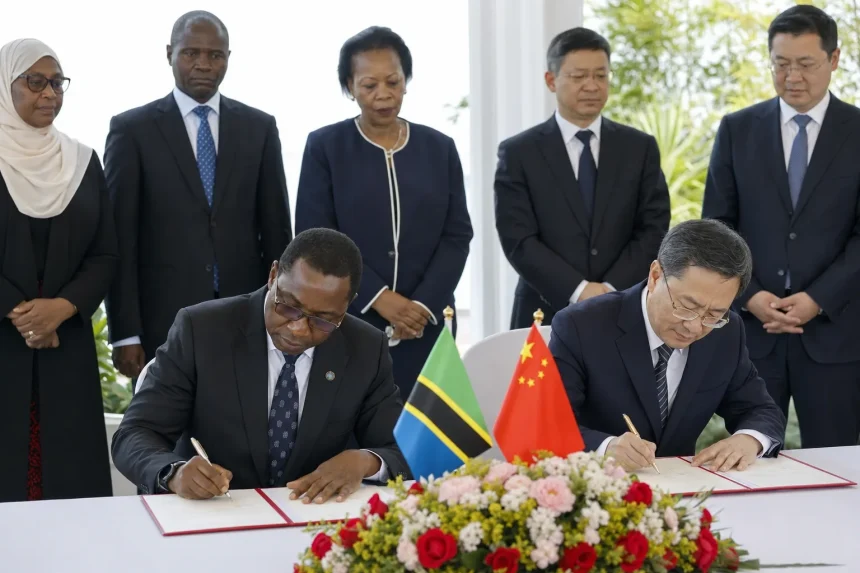
Tanzania has signed an agreement with China to expand the Jakaya Kikwete Cardiac Institute at Mloganzila, a project intended to increase access to specialised cardiovascular care and reinforce the country’s role as a regional medical hub.
Agreement moves project into implementation
The 112bn/- agreement covers the expansion of the Jakaya Kikwete Cardiac Institute at Mloganzila, near Dar es Salaam. Speaking at the signing ceremony, Permanent Secretary Dr Grace Maghembe said the project had moved beyond commitments, frameworks and statements of intent into implementation. She described it as a practical demonstration of commitments made during the Ninth Forum on China-Africa Cooperation, held in Beijing in September 2024. The agreement is therefore significant not only for its value, but also because it establishes a formal basis for progressing a major healthcare expansion. The source does not identify a tendering procedure, a winning commercial supplier or the detailed allocation of responsibilities under the agreement.
New capacity is designed around specialist care
The planned Mloganzila facility will be a 100-bed hospital with three catheterisation laboratories and two state-of-the-art operating theatres. JKCI currently handles an average of 250,000 patients each year, including more than 3,000 Cath Lab procedures and 800 open-heart surgeries. The expansion is intended to double the institute’s capacity to attend to patients and carry out cardiovascular procedures. For procurement and delivery teams, the specification points to a healthcare project in which buildings, specialist medical equipment, operating capability and clinical staffing must work together. The agreement’s signing marks a project milestone, but the article does not provide a construction timetable, purchasing schedule or performance terms.
Regional access is part of the stated case
JKCI Executive Director Dr Peter Kisenge said the expansion would support the institute’s development as a leading cardiac centre in East Africa and a centre of excellence for cardiovascular medicine. He said the facility would combine advanced patient care with specialist training, research, innovation and regional capacity building. Patients from Malawi, Comoros, Kenya, Zimbabwe, Ghana, Uganda and Nigeria already use JKCI services, according to the article. Chinese Ambassador Chen Mingjian said China would continue health cooperation through medical teams, skills transfer, training and medical equipment. The project is also linked to Tanzania’s wider Universal Health Insurance programme and to the country’s growing medical tourism activity.
What the agreement tells prospective suppliers
The announcement shows how a bilateral healthcare agreement can create a framework for implementing a public-sector expansion, while leaving important procurement questions unanswered in the public account. Businesses may distinguish between the political and institutional commitment represented by the signing and the later packages needed to deliver works, equipment, training or services. No evidence in the source establishes that a competitive tender was held, that a particular supplier has been selected, or that any procurement concern has arisen. The stated objective is to expand specialised and super-specialised care for Tanzanians and patients from other African countries. Further information on delivery arrangements would clarify how competition and supplier participation will operate.
| Fact | Value |
|---|---|
| Agreement value | 112bn/- |
| Expansion site | Mloganzila |
| New hospital capacity | 100 beds |
| Cath Labs | Three |
| Operating theatres | Two |
| Annual patients currently handled | 250,000 |
| Annual open-heart surgeries | 800 |
As we sign this agreement today, it is a testament that the project is now moving into implementation.
WHY IT MATTERS
The project links a bilateral agreement to a substantial expansion of specialised public healthcare. Its delivery will depend on converting the stated clinical requirements into clear works, equipment, training and operational arrangements, while the procurement route remains unspecified in the announcement.
Reported from dailynews.co.tz, 2026-09-20. The Tender Wire is published by Otnox.