
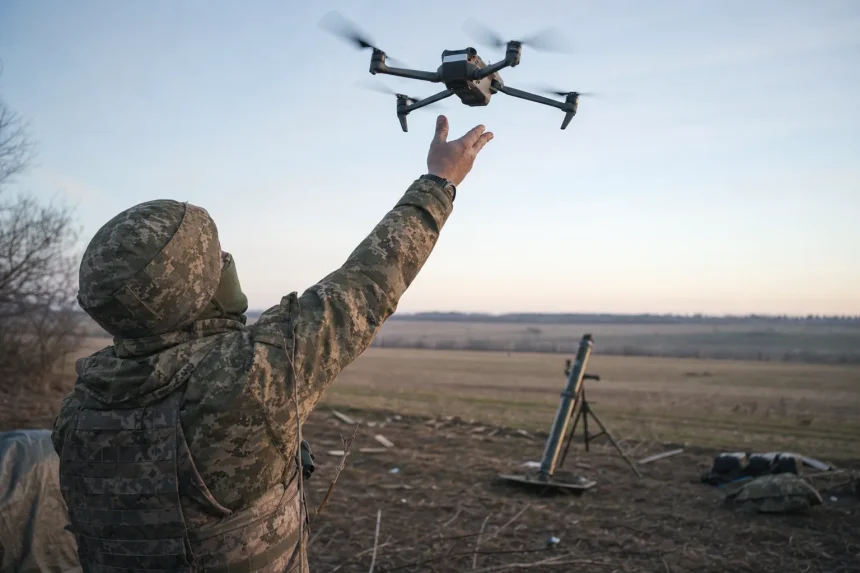
Ukraine has secured an exemption from public procurement rules so it can continue using Chinese-made components in its expanding drone industry. The arrangement reflects an operational need for affordable motors, lithium batteries and fibre-optic equipment, but it also exposes a strategic dependency on a country whose ties with Russia have damaged relations with Kyiv.
A derogation built around supply constraints
The procurement mechanism at issue is an exemption from the rules attached to European funding. Rather than requiring Ukraine to source every supported item from permitted European channels, the derogation allows Chinese components to remain eligible where Ukraine says the necessary elements are scarce in Europe. The funding is part of a €60 billion loan for defence purchases, with almost €6 billion allocated to strengthen Ukraine’s drone capabilities. In practical terms, the exemption preserves access to an established supply base while European alternatives are developed. It is an unusual route, but its purpose is to reconcile urgent battlefield demand with a procurement framework that would otherwise narrow the available market.
The figures show continued exposure
Ukraine has reduced its purchases of complete drones from China, but Chinese motors, lithium batteries and fibre-optic components remain in strong demand. President Volodymyr Zelenskyy said in a speech on 15 July that Ukraine produces 10 million drones a year. During the first six months of 2026, imports of Chinese components had already reached about 76% of the volume recorded across the whole of the previous year. A report by Ukraine’s Defence Industry Council and the Kyiv-based Snake Island Institute said Chinese imports made up 38% of the value of drone components imported in the first half of 2025. Those figures do not prove improper procurement, but they show why the exemption matters to suppliers and contracting authorities alike.
Dependency creates an integrity and resilience question
The concern is not simply where a component is made, but whether a procurement system can remain resilient when a strategically important supplier is linked to a geopolitical rival. Vita Holod, a junior researcher at Ukraine’s National Academy of Sciences, said the EU exemption showed that neither Ukraine nor Europe could yet replace Chinese suppliers at the required scale, speed and price. Ukraine has sanctioned several Chinese companies over alleged support for Russia’s military, while China denies supplying lethal weapons to either side. In 2025, Ukraine detained two Chinese nationals accused by the authorities of gathering information for Chinese intelligence about the Neptune anti-ship missile. None of these allegations establishes wrongdoing in the component market, but together they sharpen the case for scrutiny, traceability and credible alternative supply channels.
| label | value |
|---|---|
| EU funding for Ukraine’s drone capabilities | Almost €6 billion |
| Defence-loan programme | €60 billion |
| Ukraine’s stated annual drone production | 10 million drones |
| Chinese-component imports in the first six months of 2026 | About 76% of the previous year’s total |
| Chinese share of imported drone-component value in the first half of 2025 | 38% |
| Components still in strong demand | Motors, lithium batteries and fibre-optic components |
The exemption shows that neither Ukraine nor Europe can yet replace Chinese suppliers at the required scale, speed and price.
WHY IT MATTERS
An exemption can keep urgent defence procurement moving when approved alternatives are unavailable, but it also makes supplier concentration a public-interest issue. Buyers and bidders will be watching whether temporary access to Chinese components is matched by stronger traceability and credible efforts to diversify supply.
Reported from lrt.lt, 2026-10-06. The Tender Wire is published by Otnox.