

What does Ukraine’s expanding use of uncrewed ground vehicles show about the procurement rules needed for rapidly changing defence technology?
A military requirement is becoming a procurement test
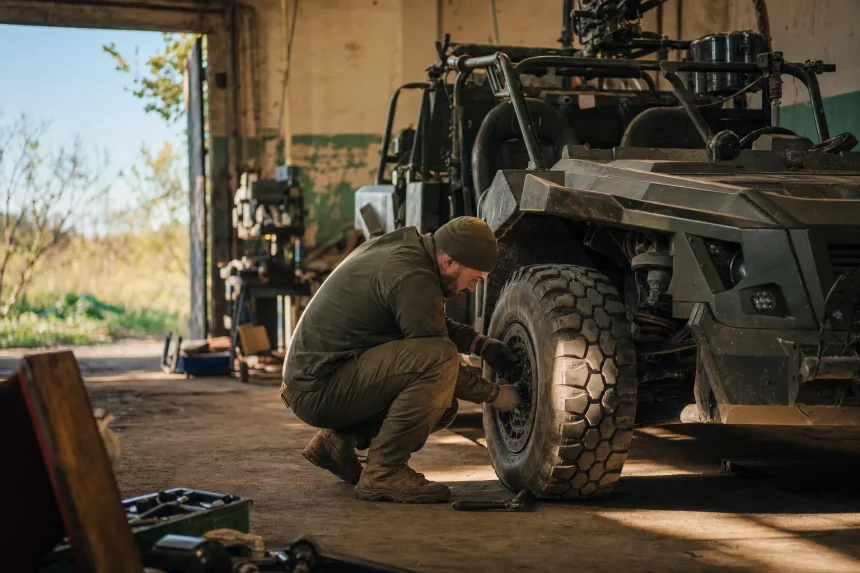
In a cramped workshop near north-eastern Ukraine’s front line, mechanics prepare four-wheeled uncrewed ground vehicles known as Hyenas for missions that once exposed soldiers to danger. The vehicles can carry explosives, ammunition or food, evacuate wounded personnel and support attacks alongside aerial drones. Ukraine’s Defence Ministry said in June that ground drones had completed more than 50,000 logistics and evacuation missions this year. For public buyers, the transferable lesson is that the requirement is functional: move supplies, recover casualties or deliver force in a hostile environment. Procurement that defines the needed outcome, rather than prescribing a fixed design, can leave room for competing suppliers to improve the solution.
The mechanism matters more than the label
Public procurement rules determine how a buyer describes its need, compares offers and changes a contract as technology develops. A conventional specification may favour a known vehicle, while a performance-based requirement can ask whether a system can carry a stated load, cross relevant ground or operate with remote control. The report does not set out an EU proposal or describe a specific tender, so it cannot establish which rule changes are under consideration. It does show why simpler and more adaptable procedures are significant: Ukraine’s units are combining tracked and wheeled prototypes, fire-fighting equipment, missile launchers and machine guns in a setting where useful designs are still evolving.
Operational evidence also sets limits
The case for faster or simpler procurement is not a case for treating every robotic system as interchangeable. Operators in the NC13 unit said ground vehicles struggle with physical obstacles and cannot clear a building or trench as infantry can. They are also not produced in sufficient numbers to operate in swarms like aerial drones. The report describes daily operations, including a vehicle towing bombs to a logistics bridge and another using a machine gun while aerial kamikaze drones attacked from above. Those examples point to contracts that test interoperability, safety, maintenance and the limits of the equipment, alongside its headline capability.
Competition can support adaptation without removing scrutiny
Ukraine’s Third Army Corps wants to replace about a third of its front-line soldiers with these systems by the end of the year, according to its commander Andriy Biletsky. That ambition illustrates the pressure on buyers to acquire useful technology while it is still developing. A simpler EU procurement framework, if designed around clear outcomes and proportionate checks, could help public authorities compare innovative offers without locking them into yesterday’s equipment. The source provides no evidence that such a framework has been adopted or that any supplier has won a contract. Its evidence is operational: robots are already taking on dangerous tasks, but human judgement and conventional infantry remain necessary.
IN NUMBERS
For procurement professionals, Ukraine’s experience is a reminder that innovation is not secured by removing competition or oversight. It is secured by stating the mission clearly, allowing credible alternatives to compete and testing whether proposed systems work alongside people and existing equipment. The report shows the potential of uncrewed ground vehicles, not a finished procurement model.
Reported from vijesti.me, 2026-09-11. The Tender Wire is published by Otnox.