

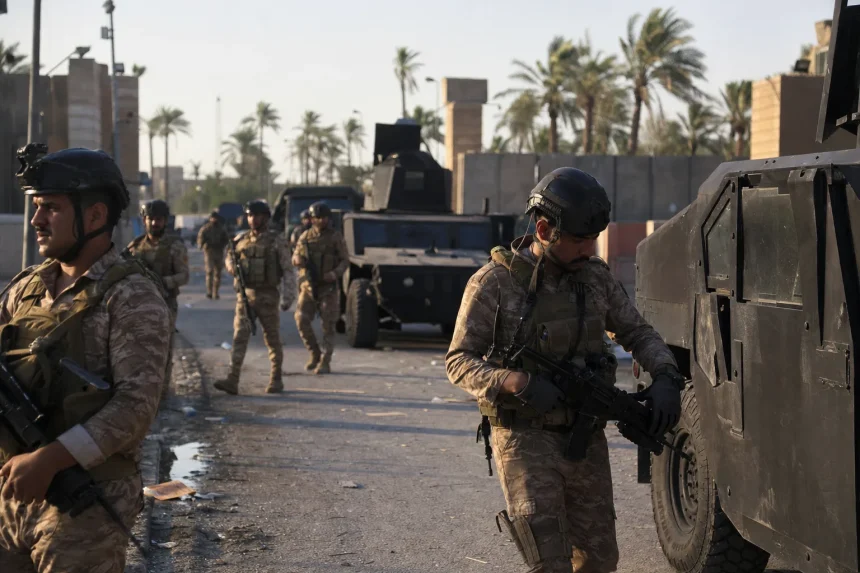
A dawn security operation inside Baghdad’s heavily protected Green Zone has given Iraq’s new prime minister an early test of his promise to fight corruption without red lines. The arrests and reported seizures have been welcomed by many Iraqis, but similar opening gestures by previous prime ministers ended with corruption charges and public services still in ruins.
A crackdown inside the protected zone
In the early hours of 28 June, Iraq’s Green Zone was sealed from within. US-made Abrams tanks moved through the streets while black-clad counter-terrorism units spread across the area, which contains the presidential palace, parliament, the prime minister’s office, the US embassy and the homes of politicians. Nearly 50 people, including a dozen MPs and senior officials, were detained. Authorities also seized hundreds of millions of dollars in cash and gold, according to the source article. Images said to show safes, jewellery and dollar-filled suitcases circulated widely, although the article does not establish the ownership or legal status of those items. The operation was unusual because the gates were used to stop people inside leaving, rather than to keep protesters outside.
A promise Iraqis have heard before
Prime Minister Ali al-Zaidi took office in early May after months of negotiations among the Coordination Framework, a bloc of major Shia parties and parliamentary figures. A wealthy businessman with little political experience, he promised to support local industry, agriculture and young people, while highlighting the disarming of pro-Iranian factions and a corruption fight with no red lines. A government insider described the raids as an “earthquake” intended to warn politicians that the same action could reach them. That is the government-side interpretation, not an established finding of guilt. The caution is significant because the previous two prime ministers also began by announcing the exposure of major corruption networks, before leaving office amid corruption charges of their own.
How muhasasa distributes state power
The system at the centre of the dispute is muhasasa, a power-sharing arrangement devised by Iraqi opposition parties in exile in the 1990s and adopted after the 2003 US invasion. It reserves the premiership for a Shia, the presidency for a Kurd, and distributes government posts among Sunni, Shia, Kurdish and other political factions. In practice, the source article says, negotiations over ministries can become bargaining over access to lucrative institutions. When a Shia holds the oil ministry, for example, a Sunni deputy may be selected through another round of party horse-trading, with other administrative posts used as part of the exchange. This mechanism is transferable to procurement: control over an institution can shape who manages contracts, appointments and the rules governing public money.
Where contracts become vulnerable
An international banker hired by a previous government to help clean up the system alleged that political parties had built “states within the state”, with seven or eight mini-states siphoning between 5% and 10% of every government contract. The allegation was not independently proven in the source article. It describes a wider administrative problem in which accumulated and often conflicting regulations can obstruct a state function, from issuing an identity card to signing a multibillion-dollar contract, until a bribe is paid. That account points to a procurement risk beyond the identity of any single minister: fragmented political control, party-linked appointments and rules that can be weaponised may make competition and contract delivery dependent on informal payments. The raids will therefore be judged not only by arrests, but by whether the system changes.
| Fact | Detail |
|---|---|
| Operation | Gates closed in the early hours of 28 June |
| Detentions | Nearly 50 people, including a dozen MPs and senior officials |
| Seizures | Hundreds of millions of dollars in cash and gold |
| System | Muhasasa distributes government posts among political factions |
| Contract allegation | Seven or eight mini-states siphon between 5% and 10% of every government contract |
| Prime minister | Ali al-Zaidi, inaugurated in early May |
What we are seeing … is a prime minister trying to dismantle the financial empires of the political parties.
WHY IT MATTERS
For businesses bidding for government work, the case illustrates how a formal contract process can be affected by political control over ministries and state institutions. The source article records allegations of systematic extraction from contracts, but does not prove them. A durable clean-up would require more than high-profile arrests: it would need state institutions able to apply their rules without obstruction, bribery or party interference.
Reported from theguardian.com, 2026-09-13. The Tender Wire is published by Otnox.