


This piece explains how a construction contract dispute led a court to hold the responsible professional and a co-defendant liable for structural defects.
A construction contract ended in a confirmed award
Argentina’s Cámara Segunda de Apelación en lo Civil y Comercial confirmed a 70 million-peso award against the professional responsible for building a family home in La Plata. Expert reports found serious defects in beams, columns and slabs, and said the structure’s future performance could not be guaranteed without further studies. The project had also suffered delays, incomplete work and defects that failed to meet minimum safety standards. The first-instance judgment awarded compensation for material damage and moral damage, and the appeals court upheld the decision. It also ordered interest from the date of the judgment.
The court treated the household project as a shared interest
The defendants argued that one claimant could not seek compensation because she had not signed the contract, while the professional’s wife argued that receiving bank transfers did not make her responsible for the work. The court rejected both positions. It found that the damage affected the couple’s shared property and that the wife’s receipt of funds showed a unit of professional management. The ruling cited article 1716 of Argentina’s Civil and Commercial Code, which requires damage caused by breach of the general duty not to harm to be repaired. It also cited article 461 when addressing joint liability linked to the household’s support.
Expert evidence defined the failure, not only the delay
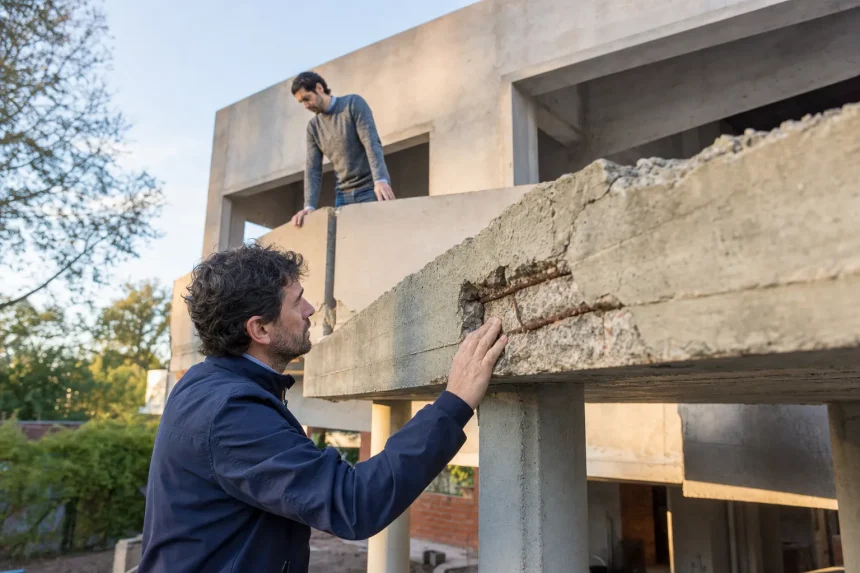
Architectural and engineering reports were central to the result. They described problems in the reinforced-concrete structure, badly executed columns, deformed beams, exposed reinforcement and incomplete roofs, alongside leaks, deficient masonry and missing finishes. The experts also identified altered foundations, poorly resolved roof sections and stairs requiring complete reconstruction. They concluded that the home was uninhabitable and warned that repairing some areas could be uneconomic compared with rebuilding them. The defendants challenged the reports because they did not include highly complex studies and because the structure had not collapsed. The court said neither point removed the duty to deliver a sound and properly completed building.
Good faith shaped responsibility after the deadline
The judgment rejected the idea that expiry of the contractual deadline released the professional from responsibility. It held that contracts must be performed in good faith and that the homeowner cannot be left with every risk while the builder is freed without delivering the agreed work. The case also illustrates a transferable feature of construction disputes: where the party receiving and administering funds does not explain their use, the court may assess that silence alongside documentary, banking and expert evidence. The ruling rejected claims for lost profits and punitive damages because they were not sufficiently proved, while confirming compensation for material and moral damage.
IN NUMBERS
The decision does not establish that every construction defect produces the same award. It shows instead how contractual scope, payment records, technical inspections and the condition of the completed work can determine responsibility when a building project fails.
Reported from infobae.com, 2026-09-13. The Tender Wire is published by Otnox.