

Tanzania and South Korea have agreed to accelerate projects backed by a $2.5-billion financing commitment through South Korea’s Economic Development Cooperation Fund, while reviewing delays, project scope and investment opportunities in digital infrastructure.
A financing commitment enters the implementation phase
The agreement centres on South Korea’s Economic Development Cooperation Fund, or EDCF, and a financing commitment valued at $2.5 billion, approximately 6.625 trillion Tanzanian shillings. Tanzania’s Finance Minister, Ambassador Khamis Mussa Omar, said the two countries had agreed to speed up implementation across transport infrastructure, technology, industry, culture and health. The mechanism is development financing tied to jointly agreed projects, rather than a single contract. Its delivery depends on the parties progressing feasibility studies, detailed engineering designs and subsequent implementation. Omar said Tanzania valued the partnership but warned that delays by either side could weaken the commitments already made.
Project preparation is part of the procurement challenge
The discussions highlighted that an agreed financing package does not by itself put a project into construction or procurement. Omar called for closer coordination and decisive action to address delays in feasibility studies and detailed engineering designs, saying some projects had taken several years to reach implementation. The two sides agreed to monitor projects pledged during President Samia Suluhu Hassan’s 2024 visit to South Korea. The Smart ICT College in Dodoma is expected to be the first of those projects to enter implementation in the near future. Other projects include the Zanzibar International Convention and Exhibition Centre, Binguni Referral Hospital, Muhimbili National Hospital and the Ifakara-Mahenge road.
Scope and cost will be reviewed for SGR coaches
The proposed procurement of passenger coaches for Tanzania’s Standard Gauge Railway was discussed separately. Tanzania and South Korea agreed to jointly review the project’s cost and scope to ensure efficient implementation. That approach illustrates a feature of development-financed procurement: a project can be reassessed before implementation when its planned requirements or costs need closer examination. The source does not state whether a tender has been issued or identify suppliers. The Ifakara-Mahenge road was also considered in connection with the development of the graphite mining project in the area, linking transport infrastructure planning with a wider development objective.
Digital infrastructure is being presented as an investment opportunity
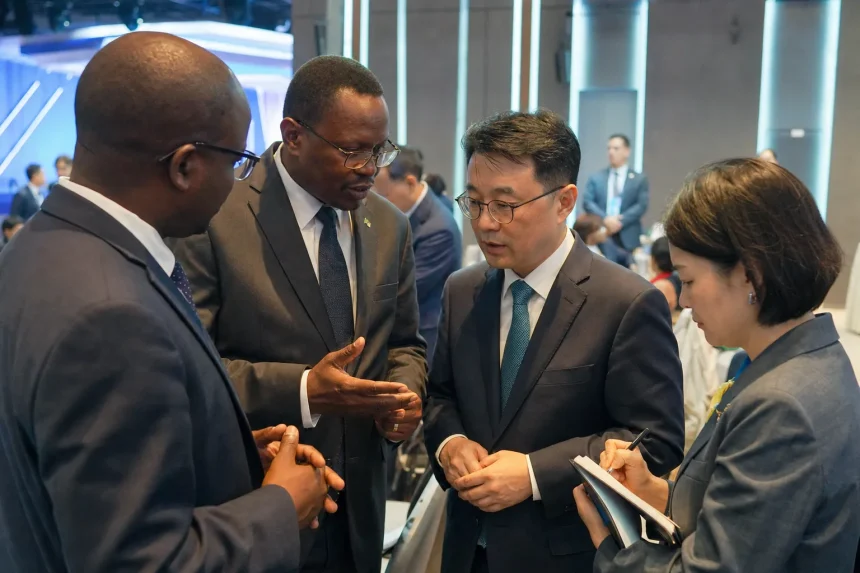
Information and Communication Technology Minister Angellah Kairuki used the forum to invite South Korean investors and technology companies to participate in Tanzania’s digital infrastructure. The areas identified included data centres, expansion of 5G networks, fibre connectivity and telecommunications infrastructure such as communication towers. She also cited e-government technology, financial technology, health and medical technologies, and tools to improve agricultural production and the wider agricultural value chain. Kairuki said Tanzania was seeking capital for the Tanzania Telecommunications Corporation, including investment in fibre networks, TTCL shops and mobile services, and that some investors had expressed interest in partnerships.
| Item | Source fact |
|---|---|
| Financing commitment | $2.5 billion, approximately 6.625 trillion Tanzanian shillings |
| Financing mechanism | South Korea’s Economic Development Cooperation Fund |
| Priority sectors | Transport infrastructure, technology, industry, culture and health |
| First expected project | Smart ICT College in Dodoma |
| Rail project under review | Passenger coaches for the Standard Gauge Railway |
| Forum theme | Harnessing AI and Digital Infrastructure for Africa’s Transformation |
Delays by either side could undermine the commitments made.
WHY IT MATTERS
For businesses seeking development-financed work, the discussions show that project preparation remains central to market access. Feasibility studies, detailed engineering designs, cost and scope reviews, and monitoring can all affect when a financed project reaches implementation. Tanzania is also seeking private investment in digital infrastructure alongside the public projects covered by the EDCF commitment.
Reported from dailynews.co.tz, 2026-09-12. The Tender Wire is published by Otnox.