

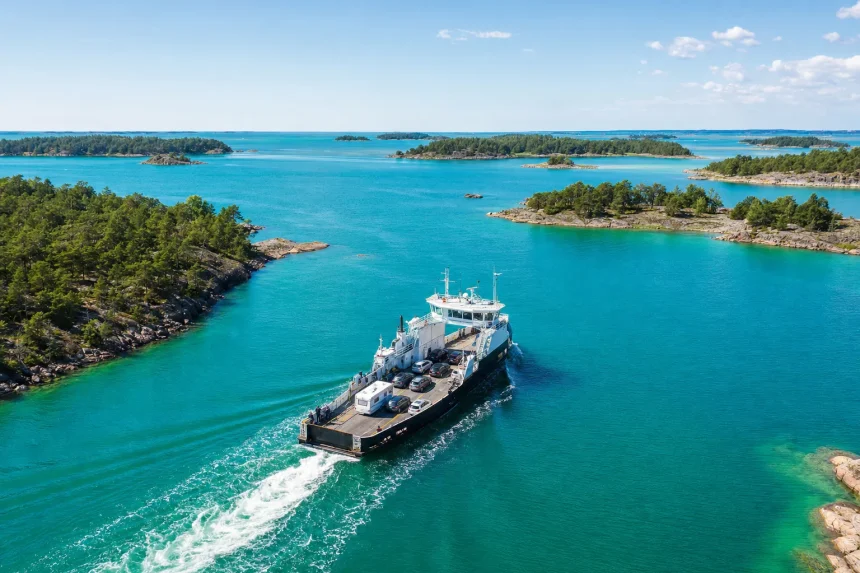
Åland is an autonomous, Swedish-speaking archipelago province of Finland, scattered across thousands of islands and skerries between Stockholm and Turku. Only a handful of those islands carry roads that go anywhere, and for the rest the ferry is not a convenience but the road itself — the way children reach school, the way a shop is restocked, the way anyone leaves at all. A regional government in that position does not treat maritime traffic as one line of the transport budget among many. It is the transport budget, and the decision about who sails is a decision about whether the outer islands remain places where people can live.
KEY NUMBERS
The notice is titled simply Färjetrafik 2028-2042 and it carries an estimated value of €340,000,000. It was published on 5 June through hankintailmoitukset.fi, Finland’s national notice portal, and bids close on 2 August — this coming Sunday. The name states the scope more plainly than most procurement documents manage: the contract covers the archipelago’s ferry traffic for the fourteen years from 2028 to 2042, a period long enough that a child starting school when the service begins will have finished university before it ends.
What makes it worth stopping on is not the figure by itself but the figure next to everything else this buyer does. Ålands landskapsregering has 41 distinct notices on our record, running from March 2025 to July 2026. Set the ferry contract aside and the remaining 38 have a median value of €950,000 and add up, in total, to €65.9M. The single ferry contract is 358 times that median and 5.2 times the sum of all of them. Sixteen months of ordinary public purchasing by an entire regional government — road surfacing, a lorry, a payroll system, gravel for winter grit, occupational health, language training — fits five times over inside one procurement.
The contract is also, by a wide margin, the largest thing closing anywhere in Finland this week. The next biggest is a project management service at €16M, which makes the ferry contract roughly twenty-one times the size of its nearest competitor for a bidder’s attention. Everything else in the Finnish week is in the single-digit millions: ambulances for Lapland, cardiology supplies, a licensing channel for Broadcom software, aggregates and growing media for the city of Espoo.
| Notice | Published | Value |
|---|---|---|
| Färjetrafik 2028-2042 | 5 Jun 2026 | €340,000,000 |
| Kollektivtrafik landsortstrafiken | 18 Jun 2025 | €14,782,320 |
| Ombyggnad Snäckö färjfäste | 22 Dec 2025 | €6,000,000 |
| Beläggningsarbeten 2025-2026 (2027) | 24 Mar 2025 | €6,000,000 |
| Elektrifiering linfärja F-123 | 24 Mar 2025 | €3,694,776 |
| Sysselsättningsfrämjande utbildning i svenska | 22 Apr 2026 | €3,600,000 |
The buyer has not rushed. The same €340M scope appeared twice in February, once as a procurement notice and once explicitly as a request for information — an invitation to the market to say what it could offer before the terms were fixed. Publishing an RFI five months ahead of the real notice is what a buyer does when it knows the number of firms capable of running an archipelago ferry network for fourteen years is small, and that the terms will decide whether any of them bid at all. Between February and June the substance of that dialogue is not public; the timeline is.
The reason a fourteen-year term is worth noticing is that it settles the question for a very long time. Whoever wins will be operating these routes into the 2040s, through at least one full replacement cycle of the vessels themselves, and the specification written now will determine what those vessels are — how they are fuelled, how often they sail, which islands stay connected in January. A contract of that length is less a purchase than a piece of infrastructure policy, decided in a procurement notice.
Sixteen months of ordinary public purchasing by an entire regional government fits five times over inside one procurement.
WHY IT MATTERS
Long contracts are where markets get settled. A fourteen-year award closes a route to new entrants for the length of a career, and the terms fixed in the specification — vessel type, fuel, frequency, which islands are served in winter — outlive the government that signed them. For suppliers the lesson is about timing rather than size: the RFI in February was the moment to shape those terms, and by the time the notice appeared in June the shape of the thing was already set.
Data: Otnox — live procurement intelligence across 56 markets. Basis: 41 distinct notices published by Ålands landskapsregering, values as advertised rather than awarded, 2025-03-24..2026-07-08. Reproducible in the Otnox platform.