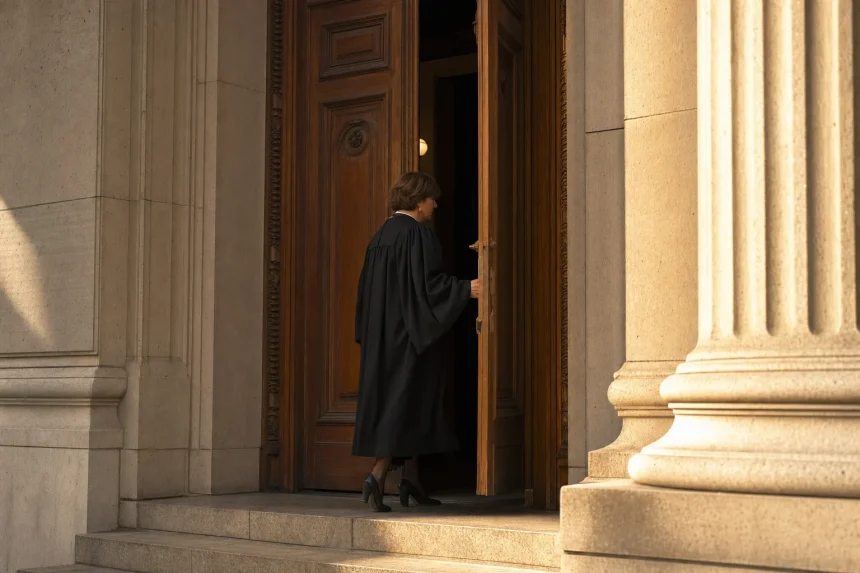
This piece explains how the court assessed the request to end the criminal action and the prosecution’s attempt to challenge the dissenting judge.
A split over the case deadline
Three judges of the Third Collegiate Court of the National District have taken different positions on applications by several defendants to extinguish the criminal action in the alleged corruption case led by former Finance Minister Donald Guerrero. The court’s president, Arlín Ventura Jiménez, issued a dissenting opinion, finding that the maximum period for the proceedings had expired and that the criminal action should therefore be declared extinguished. Leticia Martínez Noboa and Eveline Rodríguez reached the opposite view, holding that the period permitted by law had not yet elapsed.
What extinction of the criminal action means
The dispute concerns the reasonable duration of criminal proceedings. An extinction application asks the court to end the criminal action because the legally permitted period for continuing it has been exhausted, rather than deciding the underlying allegations on their merits. Ventura Jiménez considered that the time limit had already run out. Her colleagues interpreted the applicable period differently and concluded that the case remained within the legally allowed timeframe. The source does not report a finding that the corruption allegations have been proven.
The prosecution’s challenge was rejected
After Ventura Jiménez adopted her position, the Public Prosecution challenged her participation, arguing that she was not in a position to continue examining the evidence at trial. Martínez Noboa and Rodríguez rejected that request. In procedural terms, the decision kept the president of the tribunal involved despite her dissent, while leaving the disagreement over the duration of the case clearly recorded. The episode shows how a panel can preserve a majority decision while formally setting out a judge’s contrary interpretation of a procedural time limit.
The judges involved
Ventura Jiménez is a law graduate of the Universidad Nacional Pedro Henríquez Ureña and holds a master’s degree in Constitutional Justice Administration from the National School of the Judiciary. Her previous judicial roles included the First Chamber of the Special Traffic Magistrates’ Court in Villa Altagracia, the Magistrates’ Court of Santo Domingo Norte and the Tenth Investigating Court of the National District. She later served on the Third Collegiate Court and became its substitute and then presiding judge. The source identifies Martínez Noboa and Rodríguez as the judges who rejected the prosecution’s challenge.
IN NUMBERS
The ruling records a judicial disagreement about when a criminal case has lasted too long and confirms that the prosecution’s request to remove Ventura Jiménez was not accepted by the other two judges. The corruption allegations remain allegations; the reported decision concerns procedure, not a finding of guilt.
Reported from diariolibre.com, 2026-09-17. The Tender Wire is published by Otnox.