

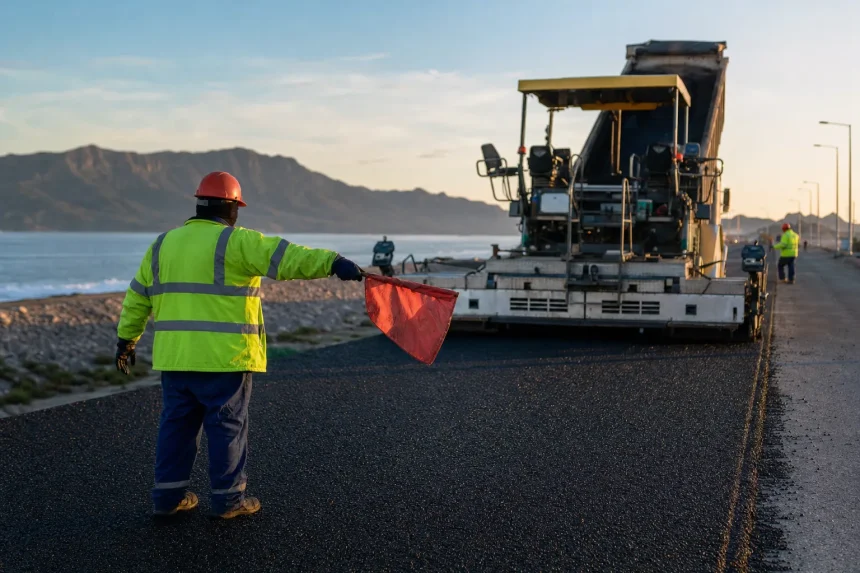
Mexico’s government has announced a large road-building programme spanning construction, modernisation and expansion, with funding from the federation and mixed-investment structures. The plans cover priority roads, free roads, bridges, interchanges, motorways and projects intended to improve links between ports, states and border crossings.
A national programme with several workstreams
The government of Claudia Sheinbaum expects to invest 647,000 million pesos in roads and highways during its administration, according to Jesús Antonio Esteva Medina, secretary of Infrastructure, Communications and Transport. The programme is intended to intervene in almost 11,400 kilometres and combines new construction with modernisation and widening. Priority roads account for 3,161 kilometres and 100,540 million pesos. Of that programme, 407 kilometres have been completed, 1,113 kilometres are under construction and 1,637 kilometres are scheduled to be built between 2027 and 2029. The wider portfolio also includes 4,554 kilometres of free roads, 402 bridges and 802 kilometres of motorways.
Mixed investment changes the role of the private sector
The announcement also sets out a procurement and financing mechanism that differs from a wholly public delivery model. Banobras said there are 19 road projects using mixed-investment arrangements: 14 have been approved by the SICT and five remain under analysis. The estimated total investment is 213,868 million pesos. Under the structure described, the state will retain all or a majority of the concessions, while private companies will participate in construction, maintenance and operation. This means the private role is tied to a concession framework and to delivery over the asset’s operating life, rather than being limited to a single construction contract. The source does not specify tender dates, award methods or the companies involved.
Projects connect ports, states and border crossings
The projects named by the SICT illustrate the range of assets covered by the programme. The Guaymas-Chihuahua road is intended to strengthen the connection between the port of Guaymas and northern Mexico, with 74 kilometres planned for 2026 after 10 kilometres were built the previous year with support from the Navy. The Mexico-Querétaro alternative route is expected to begin in November 2026 and conclude in April 2030. Other projects include the Tepic-Puerto Vallarta and Tepic-Compostela motorways, the Las Varas-Platanitos corridor in Nayarit, the Gulf corridor linking Tampico, Ciudad Victoria and Reynosa, and the Piedras Negras-Puerto Verde and Nuevo Laredo 4 and 5 border bridges.
| Measure | Value |
|---|---|
| Planned road investment | 647,000 million pesos |
| Road network intervention | Almost 11,400 kilometres |
| Priority roads programme | 3,161 kilometres and 100,540 million pesos |
| Free roads programme | 4,554 kilometres and 32,000 million pesos |
| Motorway programme | 802 kilometres and 100,000 million pesos |
| Mixed-investment projects | 19 projects and 213,868 million pesos |
| Estimated direct employment | 10,077 jobs |
The state will retain all or a majority of the concessions, while private companies will participate in construction, maintenance and operation.
WHY IT MATTERS
The programme gives suppliers several distinct markets to assess: priority roads, free-road works, bridges, motorways and concession projects. Mixed investment is particularly significant because private participation may cover construction, maintenance and operation while the state retains all or a majority of the concession. The announcement describes the structure and project pipeline, but not forthcoming tender conditions or awards.
Reported from eleconomista.com.mx, 2026-09-17. The Tender Wire is published by Otnox.