


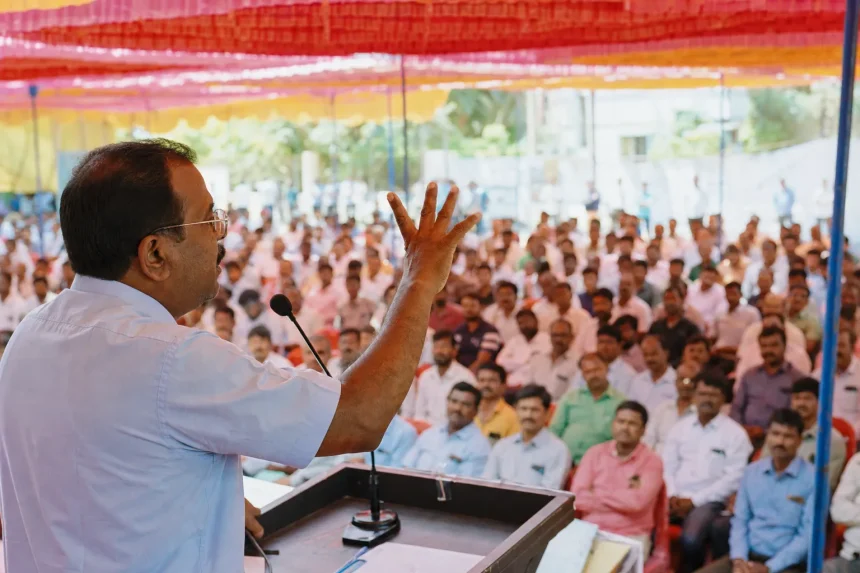
A trade union has called for legislation to regularise contract and outsourced employees in Karnataka’s power sector, alleging that workers are being used in roles of a permanent nature without equal pay or revised minimum wages. The claims were made at a workers’ convention in Hubballi. The report records allegations from union representatives, not an established finding against the government.
What the union alleges
S. Varalakshmi, State general secretary of the Centre of Indian Trade Unions and honorary president of the Karnataka State Electricity Workers’ Federation, alleged that the government was engaging contract and outsourced workers for several departmental jobs, including work of a permanent nature. She said the government should be a model employer but was instead exploiting workers. Ms. Varalakshmi also alleged that the principle of equal pay for equal work was not being implemented and that the recently revised minimum wages had been withheld. The source does not provide the number of workers affected or record a response from the government.
How the staffing arrangement works
The issue concerns the distinction between direct public employment and labour engaged through contract or outsourcing. Under the arrangement described by the union, people perform work for government departments or the power sector without being treated as permanent departmental employees. That can give the public body access to labour through a contractual staffing route, while employment status, pay and service security remain separate questions. The union’s request for legislation to regularise workers would address that status. The source does not describe a particular tender, supplier or contract, so it is not possible to assess the purchasing process itself from this report.
The demands before the next convention
Ms. Varalakshmi urged the government to enact legislation to regularise contract and outsourced employees, saying they were facing severe hardships and exploitation and were effectively living under a form of bonded labour. Those statements are allegations by the union and have not been proven in the report. J. Satyababu, State president of the Karnataka State Electricity Workers’ Federation, said a State-level convention would be held in Bengaluru on September 29. Workers in power generation, supply and distribution are expected to press for revised minimum wages, regularisation of services and other demands.
Why procurement readers should note the distinction
For public buyers and businesses, the case illustrates why the route used to obtain labour matters alongside the service being delivered. A contract or outsourcing model may govern how workers are engaged, but the union is asking whether workers carrying out ongoing departmental work should receive a different employment status and pay treatment. That is a policy and employment question rather than evidence of wrongdoing in a particular competition. The report identifies no procurement exercise, award decision or contractor, and contains no finding that procurement rules were breached.
| Fact | Details |
|---|---|
| Location | Hubballi |
| Speaker | S. Varalakshmi |
| Organisations | CITU and the Karnataka State Electricity Workers’ Federation |
| Workers covered | Contract and outsourced employees |
| Sector | Power generation, supply and distribution |
| Next convention | State-level convention in Bengaluru on September 29 |
The government, which is expected to be a model employer, is exploiting contract and outsourced workers by engaging them for several jobs in its departments, including those of a permanent nature.
WHY IT MATTERS
Outsourcing can change how public services obtain labour without resolving questions about permanence, pay and regularisation. For procurement professionals, the report is a reminder to distinguish the purchase of a service from the employment conditions attached to delivering it. The allegations remain unproven, and the source gives no details of a specific contract or supplier.
Reported from thehindu.com, 2026-09-11. The Tender Wire is published by Otnox.