


This piece explains how a judicial suspension affects Colombia’s proposed public pilot for aerial fumigation and what it means for any future operational procurement.
The court has paused the activity, not declared the plan unlawful
A judge in Puerto Asís, Putumayo, ordered the temporary suspension of any aerial spraying with glufosinate ammonium in the department. The order followed a tutela brought by Jhonatan Enrique Meneses Valencia, representing the Fundación Tiempo de Cambios para la Transformación Social. The claimant alleged possible violations of rights to health, water and a healthy environment, citing potential effects on people and nearby crops. The judge expressly stated that the action did not challenge the legality of the national government’s Resolution 007. The suspension will remain while the authorities and linked parties provide requested information and the court gathers material to decide the wider dispute.
The planned operation was framed as a controlled pilot
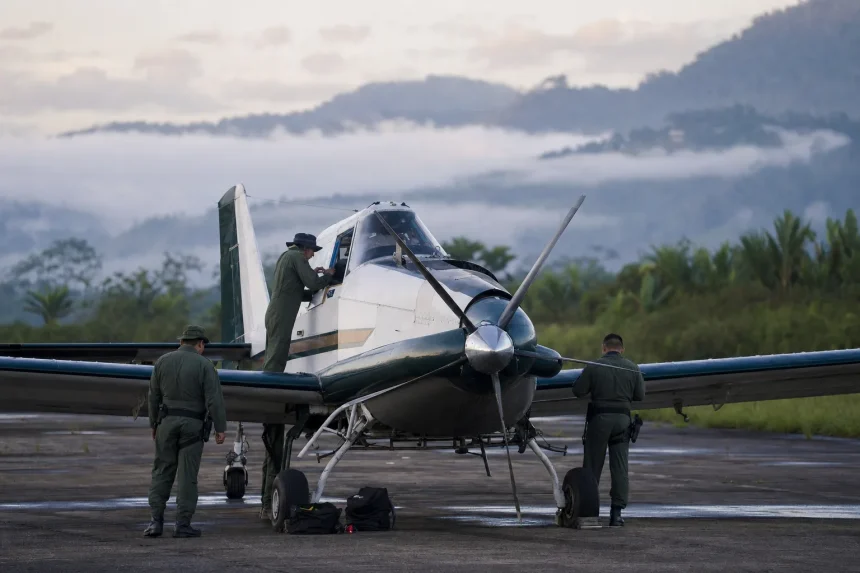
The Consejo Nacional de Estupefacientes announced the pilot through Resolution 007 of 18 August 2026. The Police Anti-Narcotics Directorate described it as part of the Esmeralda Plus strategy and said it was designed as an experimental, controlled, limited, temporary and evaluable phase. The stated purpose was to test the effectiveness of glufosinate ammonium in eradicating coca crops, while examining positive and negative effects on people and cultivation in the area. The Directorate said two AT-802 aircraft were available to apply the authorised product only within approved polygons and under technical, operational, environmental and safety conditions.
What this means for public contracting
The reported mechanism is a government-authorised pilot rather than a nationwide programme. That distinction matters in procurement: an authority can define a limited operational test, specify where and under what conditions it may occur, and evaluate the results before deciding whether a broader service or supply requirement is justified. The source does not report a tender, contract award or supplier selection. Instead, the immediate constraint is judicial. Until the requested evidence is supplied and the court considers the tutela, the state cannot carry out the proposed spraying in Putumayo, even though the underlying resolution has not been declared illegal.
The dispute sits within a longer health and policy debate
The proposed chemical would replace glyphosate in aerial fumigation, a practice suspended in 2017 because of concerns about long-term health effects on people exposed to it over the years. The article also reports that cases of allergies in children linked to glyphosate fumigation were documented in Cauca in 2009. Separately, a United Nations Office on Drugs and Crime report recorded 261,000 hectares of coca crops in Colombia in 2024. The government of Abelardo de la Espriella had sought to restart aerial spraying, while the court’s order requires more information before the legal and practical controversy can be resolved.
IN NUMBERS
The next step is the Colombian state’s response to the order and the submission of the information requested by the court. Until then, the proposed Putumayo pilot remains an authorised experiment that cannot proceed in the department, rather than proof that a general national spraying programme has been approved.
Reported from infobae.com, 2026-09-11. The Tender Wire is published by Otnox.