

Spain’s Government has set out more than 22,600 million in public defence commitments for companies through 2035. The spending covers 32 existing Special Modernisation Programmes, with 15 more programmes being prepared in areas including aerospace, cyber-defence, communications and weapons systems.
A decade-long spending map
The Ministry of Finance, which authorises the expenditure, has detailed the commitments attached to the Special Modernisation Programmes, known as PEMs. These projects are the route through which the Government’s Industrial and Technological Security and Defence Plan is being delivered. The 32 programmes currently defined are expected to distribute more than 2,200 million among defence companies in 2026, followed by 2,124 million in planned contracting in 2027 and 2,619 million in 2028. For the years after 2028 and up to 2035, the planned company spending is 15,600 million, although the detailed allocation has not yet been specified.
The largest programmes and suppliers
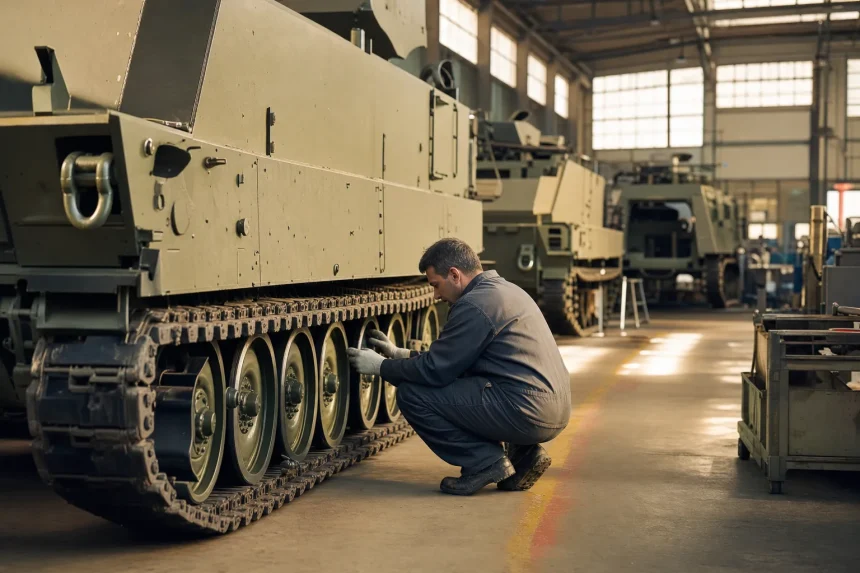
The biggest individual project is the tracked support vehicle, or VAC, with an estimated cost of more than 4,500 million. It is followed by the modernisation of the F-100 frigates, valued at 3,200 million, and the wheeled VAC, with planned spending of 2,685 million. On the current allocation, Airbus has the largest expected pipeline, at 8,100 million. A temporary joint venture between Indra and Escribano is next with 7,620 million, while Navantia has 5,800 million in its order book. The figures describe projected contract income under the current distribution, rather than a completed picture of future procurement.
How the funding and delivery model works
The PEM mechanism combines public budget commitments with industrial delivery milestones. Defence companies receive prefinancing from the Ministry of Industry, which they must repay, and record revenue when the equipment is actually delivered to the Armed Forces. Defence officials have therefore stressed that suppliers must meet delivery commitments. The 8×8 Dragón programme, produced by the Tess Defence consortium of Indra, Escribano, Santa Bárbara and Sapa, experienced delays in completing its first dozens of vehicles, although the joint company is now accelerating its commitments. This model links payment recognition to delivery rather than simply to the announcement of a programme.
Fifteen further programmes in preparation
The Defence and Industry ministries are designing 15 additional Special Modernisation Programmes, which are due to be known before the end of the year and will have retrospective effects from 1 January 2026. The new budget will include prefinancing of 2,180 million and is expected to focus on aerospace, cyber-defence, communications and weapons systems. The Government estimates that the 35 PEMs operating over the coming years will create more than 150,000 jobs and increase economic activity in almost all autonomous communities. The eventual distribution remains open, with companies waiting for details of the new programmes and the next Government set to determine how far the portfolio grows.
| Measure | Value |
|---|---|
| Total public defence commitments | More than 22,600 million through 2035 |
| Programmes currently defined | 32 |
| Planned 2026 allocation | More than 2,200 million |
| Planned 2027 contracting | 2,124 million |
| Planned spending after 2028 to 2035 | 15,600 million |
| New programmes being prepared | 15 |
The current allocation gives Airbus an expected pipeline of 8,100 million.
WHY IT MATTERS
Special Modernisation Programmes show how large defence procurements can be structured over several years: Industry provides prefinancing, suppliers repay it, and companies recognise revenue when equipment is delivered to the Armed Forces. The arrangement makes delivery performance central to the value and timing of the contract pipeline.
Reported from lavanguardia.com, 2026-09-12. The Tender Wire is published by Otnox.