

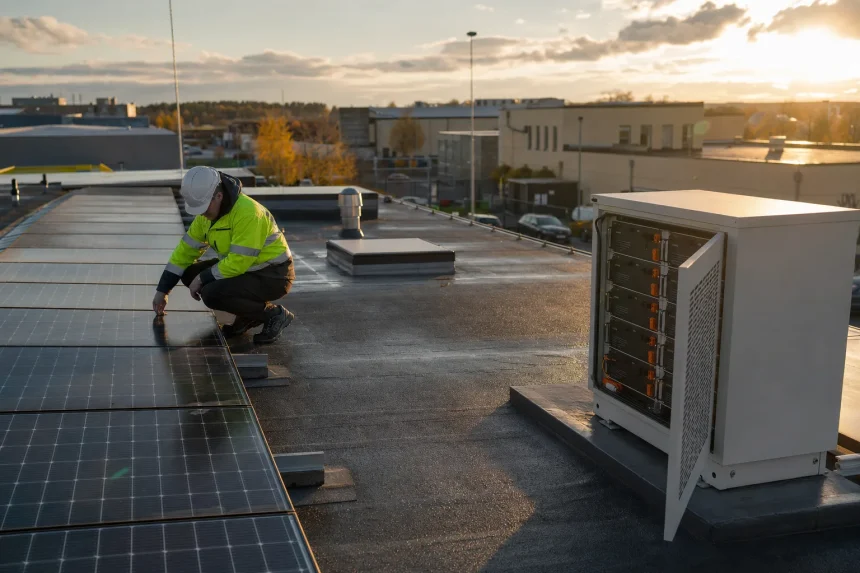
Romania’s Ministry of Energy has launched a €500 million funding call for public-sector investments in new solar generation capacity with integrated storage. The scheme is intended for self-consumption and is financed entirely through non-reimbursable funding from the Modernisation Fund.
Applications will be assessed in submission order
The call will run online through the information system of the Agency for Financing Rural Investments. Applications can be submitted from 28 September at 10:00 until 20 November 2026, or until the budget is exhausted. The ministry says projects will be selected under a “first come, first evaluated” principle, provided they meet the conditions in the guide. This is an order-based procedure rather than a ranking in which all eligible applications are compared after the deadline. For prospective suppliers and public applicants, the mechanism makes compliance with the guide and the timing of a complete submission central to the process. Project evaluation is scheduled for 23 November 2026 to 2 March 2027, while contracting will take place as projects are approved, beginning on 8 February of the following year.
A broad group of public bodies is eligible
Eligible applicants include administrative-territorial units and their subdivisions, bodies in the national defence, public order and national security systems, prison administration units, and hospitals financed entirely from public funds. The list also covers public institutions defined under Law 500/2002 on public finances, officially recognised religious denominations and their units, state higher-education institutions, and public research institutes, centres and stations. Intercommunity development associations, publicly funded social and palliative-care centres, the National Sports Agency, the Romanian Olympic and Sports Committee, and their subordinate institutions are included. Public-service broadcasters may also apply where the financing of their public mission constitutes existing aid under European state-aid rules.
Funding can cover all eligible costs within project limits
Applicants must demonstrate that the funded investment will reduce the energy cost associated with delivering the public service entrusted to them and consequently reduce the state subsidy or compensation paid. Eligible activities include buying new installations and equipment for solar generation with integrated storage, purchasing heat pumps, construction works forming part of the investment, and installation and commissioning. Funding can cover a maximum of 100% of total eligible expenditure, subject to a limit of €10 million per beneficiary, including the beneficiary’s own project and its amounts in partnerships. Maximum non-reimbursable aid is €900,000 per installed MW for projects without heat pumps and €1.1 million per installed MW for projects that include them; both ceilings are stated without VAT.
| Fact | Detail |
|---|---|
| Total call budget | €500 million |
| Application channel | Online through the Agency for Financing Rural Investments’ information system |
| Submission window | 28 September at 10:00 to 20 November 2026, or until the budget is exhausted |
| Selection principle | First come, first evaluated, subject to the guide’s conditions |
| Maximum funding rate | 100% of total eligible expenditure |
| Maximum per beneficiary | €10 million |
| Completion deadline | 31 December 2029 |
“Primul venit, primul evaluat, cu respectarea condiţiilor din ghid”
WHY IT MATTERS
The call combines solar generation and integrated storage with a first-come, first-evaluated process. It gives public bodies a route to fund projects for their own energy use, while requiring them to show how lower energy costs will reduce state subsidies or compensation.
Reported from economica.net, 2026-09-11. The Tender Wire is published by Otnox.